Introduction
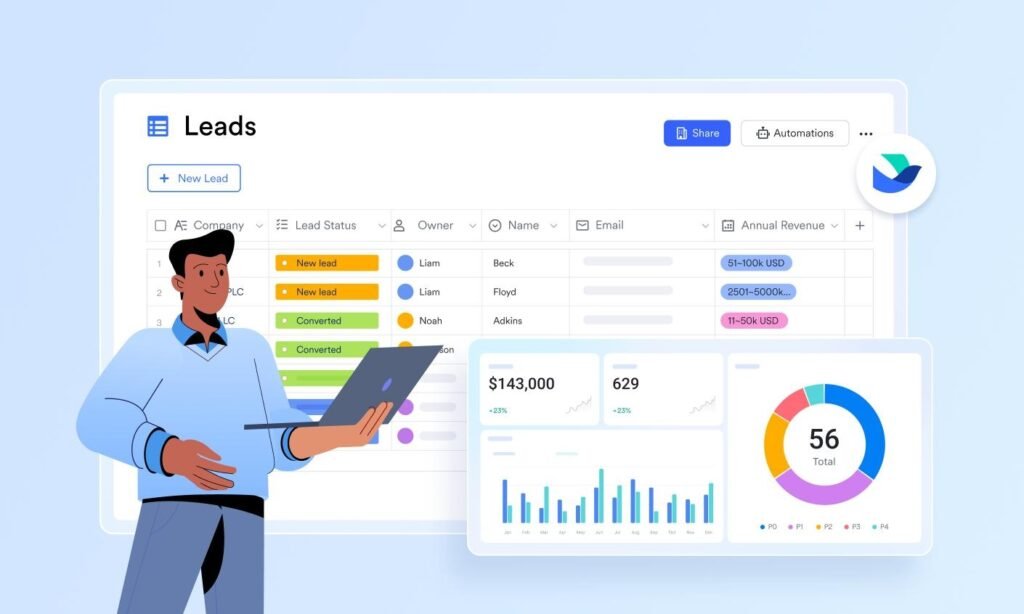
In today’s competitive business environment, managing leads and customers manually can quickly become complicated. Businesses need a reliable system to organize customer information, monitor sales activities, follow up with prospects, and improve conversions. Sales CRM Software provides a centralized solution that helps businesses manage their entire sales process more efficiently. From capturing leads and assigning prospects to sales executives to tracking conversations and measuring performance, a well-implemented CRM can make sales operations more organized and productive.
For businesses investing in digital marketing, lead generation is only one part of the growth journey. The real challenge begins after a lead enters the system. Without proper follow-ups, many valuable prospects can be lost. Sales CRM Software helps businesses create a structured process so that every lead receives timely attention and every sales opportunity can be monitored.
Saurabh Kumar, with 15+ years of experience in Digital Marketing, helps businesses strengthen their digital presence through website development, SEO, Google Business Profile optimization, social media marketing, paid advertising, automation, CRM integration, content marketing, analytics, and other digital solutions.
What Is Sales CRM Software?
Sales CRM Software is a technology solution designed to help businesses manage relationships with prospects and customers throughout the sales journey. CRM stands for Customer Relationship Management. A sales-focused CRM brings important customer and sales information into one centralized platform.
Instead of maintaining separate spreadsheets, notebooks, emails, and messaging records, businesses can use Sales CRM Software to organize information in a structured way.
A typical CRM may help teams:
- Capture and organize leads
- Store customer information
- Track sales opportunities
- Schedule follow-ups
- Manage sales pipelines
- Record customer interactions
- Assign leads to sales representatives
- Monitor sales activities
- Generate reports
- Automate repetitive tasks
- Track conversions
- Improve customer communication
The objective of Sales CRM Software is not simply to store contact details. Its real purpose is to help businesses create a more efficient and measurable sales process.
Why Businesses Need Sales CRM Software
As a business grows, the number of leads and customer interactions also increases. Managing everything manually becomes difficult and creates opportunities for mistakes.
A prospect may fill out a website form today, receive a phone call tomorrow, communicate through WhatsApp, and request a quotation a few days later. If these interactions are not recorded properly, the sales executive may forget important details.
Sales CRM Software creates a central system where sales teams can monitor the complete customer journey.
Businesses can use CRM systems to identify:
- Which leads are new
- Which leads require immediate follow-up
- Which prospects are interested
- Which deals are in negotiation
- Which customers have converted
- Which sales representatives are performing well
- Where prospects are dropping out of the sales funnel
This visibility helps management make better decisions based on actual sales data rather than assumptions.
How Sales CRM Software Improves Lead Management
Lead management is one of the most important functions of Sales CRM Software.
Digital marketing campaigns can generate leads through Google Ads, Meta Ads, SEO, social media, landing pages, websites, WhatsApp, and other channels. However, generating leads does not automatically guarantee sales.
Every lead needs proper handling.
A CRM can help businesses organize leads according to their source, interest level, location, service requirement, budget, or sales stage. Sales teams can then prioritize high-value opportunities.
For example, a business generating 100 leads every month can categorize them into:
- New leads
- Contacted leads
- Interested prospects
- Follow-up required
- Proposal sent
- Negotiation
- Converted customers
- Lost opportunities
Sales CRM Software makes this process easier because sales executives can update lead status after every interaction.
Sales CRM Software for Sales Pipeline Management
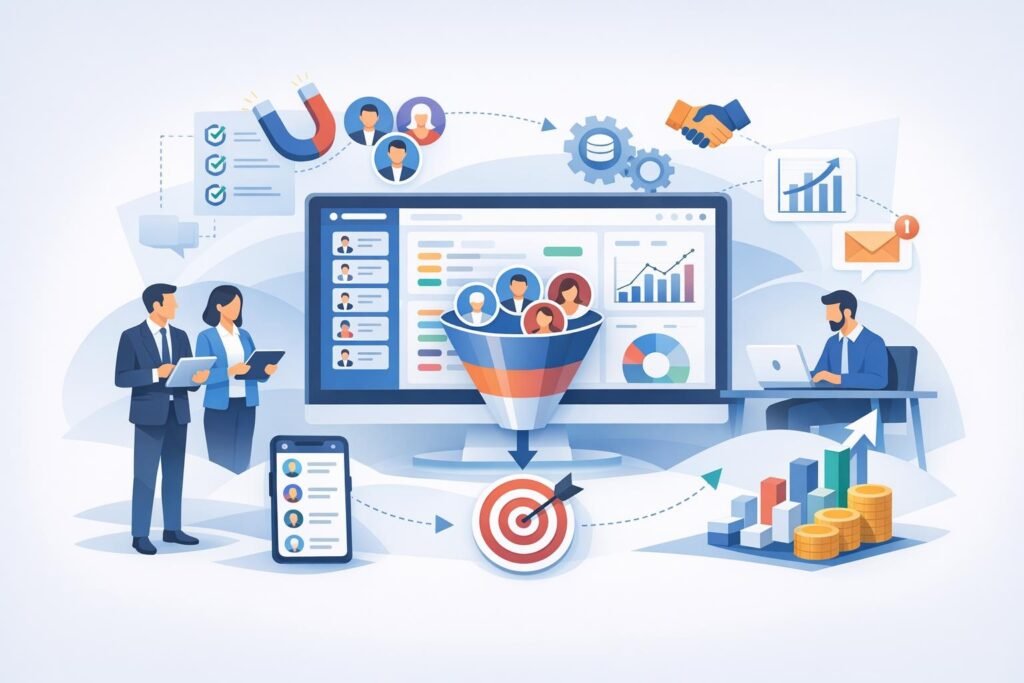
A sales pipeline represents the different stages through which a prospect moves before becoming a customer. Managing this pipeline effectively is essential for predictable sales growth.
Sales CRM Software provides businesses with a visual representation of their sales pipeline.
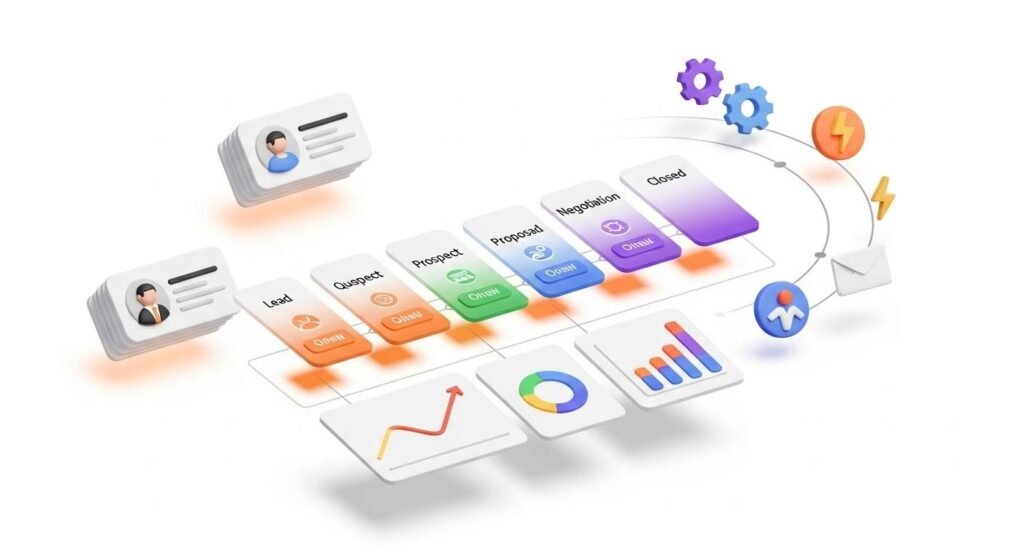
A typical pipeline may include:
- New Lead
- Lead Contacted
- Qualified Lead
- Requirement Discussed
- Proposal Sent
- Negotiation
- Closed Won
- Closed Lost
With Sales CRM Software, managers can see how many opportunities are present at every stage.
This helps identify bottlenecks. If hundreds of leads are being generated but very few reach the proposal stage, the business may need to improve lead qualification or sales communication.
Similarly, if many proposals are being sent but conversions remain low, management can analyze pricing, follow-up processes, service presentation, or sales techniques.
Sales CRM Software for Follow-Up Automation
One of the biggest reasons businesses lose potential customers is poor follow-up.
A prospect may be interested but not ready to purchase immediately. If the sales team fails to follow up at the right time, that prospect may choose a competitor.
Sales CRM Software can help businesses schedule follow-ups and create reminders for sales executives.
Depending on the CRM system, businesses can automate:
- Follow-up reminders
- Email notifications
- Lead assignment
- Customer messages
- Task creation
- Lead nurturing
- Sales alerts
- Appointment reminders
Automation reduces dependency on memory and helps sales teams maintain consistency.
When combined with WhatsApp Marketing, email automation, SMS, and chatbot solutions, Sales CRM Software can become an important part of a complete customer communication ecosystem.
Sales CRM Software for Customer Relationship Management
Sales should not end immediately after a customer makes a purchase. Long-term customer relationships can create repeat business, referrals, upgrades, and cross-selling opportunities.
Sales CRM Software allows businesses to maintain customer records after conversion.
Sales teams can use CRM data to understand:
- Previous purchases
- Customer preferences
- Communication history
- Service requirements
- Complaints or concerns
- Follow-up dates
- Renewal opportunities
- Upselling opportunities
This information enables businesses to communicate with customers more intelligently.
Instead of sending generic messages to everyone, businesses can create more relevant communication based on customer history.
Sales CRM Software and Digital Marketing Integration
Digital marketing and sales need to work together.
A business may invest heavily in SEO, Google Ads, Meta Ads, social media, content marketing, or landing pages. These activities can generate traffic and leads, but businesses also need a system to manage those leads after acquisition.
Sales CRM Software can connect marketing and sales operations.
For example:
Google Ads → Landing Page → Lead Form → CRM → Sales Executive → Follow-Up → Conversion
Similarly:
Instagram Ad → WhatsApp → CRM → Sales Team → Follow-Up → Customer
This connected process helps businesses understand where leads originate and which marketing channels generate actual business.
CRM integration can therefore improve the relationship between marketing expenditure and sales revenue.
Sales CRM Software for Sales Team Productivity
Sales executives often spend considerable time performing repetitive administrative tasks. Entering customer information into multiple spreadsheets, checking follow-up dates, searching through old conversations, and preparing reports can reduce productive selling time.
Sales CRM Software can centralize these activities.
Sales representatives can access customer information from a single platform instead of searching across multiple systems.
Managers can also assign leads to specific team members and monitor their progress.
This creates greater accountability because management can identify:
- Number of leads assigned
- Number of calls completed
- Follow-ups completed
- Meetings scheduled
- Proposals generated
- Deals closed
- Pending opportunities
By reducing administrative workload, Sales CRM Software can allow sales teams to spend more time communicating with prospects and closing opportunities.
Sales CRM Software for Sales Analytics and Reporting
Data is essential for improving sales performance.
Without proper reporting, business owners may know their total revenue but may not know exactly how that revenue was generated.
Sales CRM Software can provide valuable reports related to sales activities and conversions.
Important metrics can include:
- Number of leads
- Lead sources
- Conversion rate
- Sales pipeline value
- Average deal size
- Sales cycle length
- Follow-up performance
- Revenue by salesperson
- Lost lead percentage
- Customer acquisition performance
These insights can help management identify patterns.
For instance, if Google Ads produces fewer leads than social media but generates significantly more paying customers, the business may decide to increase its investment in Google Ads.
This is where Sales CRM Software becomes more than a sales database. It becomes a decision-making tool.
Sales CRM Software for Small Businesses
Many small businesses believe CRM solutions are only useful for large companies. In reality, Sales CRM Software can be valuable for businesses of different sizes.
Small businesses often operate with limited teams. A business owner may personally handle marketing, sales calls, customer communication, quotations, and follow-ups.
A CRM can bring structure to these activities.
For a growing business, Sales CRM Software can help create a repeatable sales process without requiring a large administrative team.
Small businesses can use CRM systems to manage:
- Local leads
- Website enquiries
- WhatsApp enquiries
- Phone enquiries
- Existing customers
- Sales follow-ups
- Service renewals
- Marketing campaigns
The key is selecting a CRM that matches the company’s actual requirements and budget.
Sales CRM Software for Service-Based Businesses
Service businesses depend heavily on enquiries, consultations, appointments, proposals, and follow-ups. Examples include digital marketing agencies, consultants, clinics, educational institutes, real estate companies, financial service providers, and professional service firms.
For these businesses, Sales CRM Software can create a structured journey from enquiry to conversion.
A digital marketing agency, for example, may receive enquiries for SEO, website development, Google Business Profile optimization, social media marketing, Google Ads, or WhatsApp automation.
Instead of handling every enquiry separately, the business can use Sales CRM Software to classify leads according to their requirements.
This makes it easier to recommend the appropriate service and maintain consistent follow-ups.
Sales CRM Software for Automation and Communication
Modern sales operations involve multiple communication channels.
Customers may communicate through phone calls, WhatsApp, email, website chat, social media, or forms.
Managing these channels independently can create communication gaps.
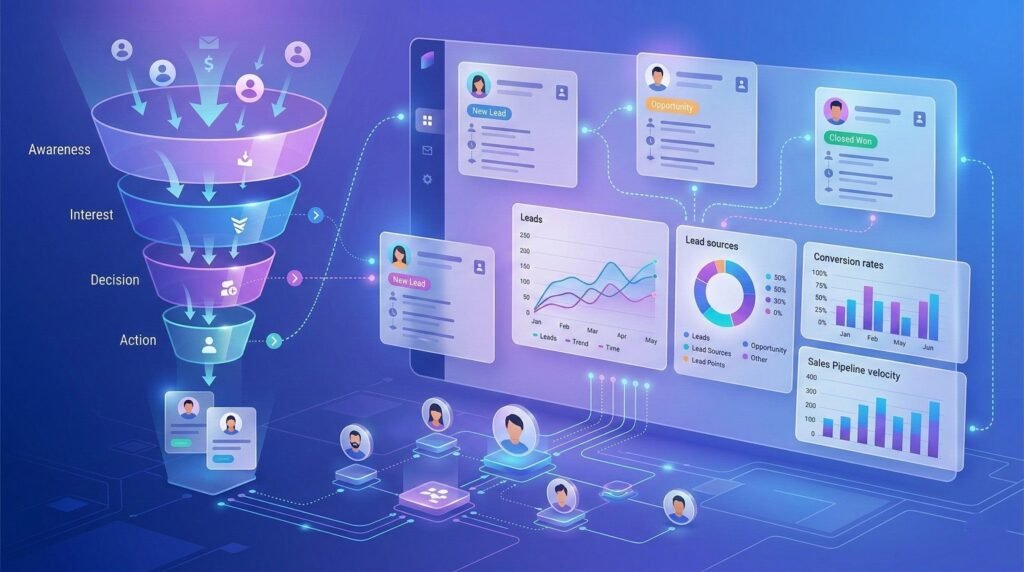
Sales CRM Software can be integrated with communication and automation systems to create a more connected customer journey.
For example, when a new enquiry arrives, an automated workflow can potentially:
- Capture the lead.
- Save customer details.
- Notify the sales representative.
- Send an acknowledgement.
- Create a follow-up task.
- Add the prospect to a nurturing sequence.
- Track subsequent communication.
When CRM integration is combined with WhatsApp Marketing, Bulk SMS Marketing, IVR, AI Chatbots, Email Marketing Automation, and Website Live Chat, businesses can build a stronger communication framework.
Sales CRM Software and WhatsApp Marketing
WhatsApp has become an important communication channel for businesses. Customers often prefer WhatsApp because it allows quick and convenient communication.
Integrating WhatsApp with Sales CRM Software can help businesses organize conversations and lead information more effectively.
Depending on the technology stack, businesses can use WhatsApp-based workflows for:
- New enquiry notifications
- Lead acknowledgement
- Appointment reminders
- Follow-up messages
- Promotional communication
- Customer support
- Lead nurturing
- Service updates
A properly designed workflow can help reduce response delays while maintaining a consistent customer experience.
However, businesses should always follow applicable messaging rules, consent requirements, and platform policies while conducting WhatsApp communication.
Sales CRM Software for Lead Nurturing
Not every prospect is ready to purchase immediately.
Some customers need additional information, price comparisons, demonstrations, consultations, or time before making a decision.
Sales CRM Software can support lead nurturing by helping businesses maintain communication over a longer period.
A nurturing strategy may include:
- Educational emails
- Product information
- Case studies
- Service updates
- Offers
- Customer testimonials
- Follow-up calls
- Consultation invitations
The objective is to remain relevant without overwhelming the prospect.
Effective lead nurturing can help businesses convert prospects who were not ready to purchase during the first interaction.
Sales CRM Software for Improving Conversion Rates
Generating more leads is not always the best solution for increasing revenue.
Businesses also need to improve the percentage of leads that become customers.
Sales CRM Software helps identify problems in the conversion journey.
For example:
If 500 leads are generated but only 10 customers convert, management can investigate:
- Lead quality
- Response time
- Sales communication
- Follow-up frequency
- Pricing
- Product presentation
- Sales objections
- Customer experience
CRM reports can provide valuable evidence about where opportunities are being lost.
Once these issues are identified, businesses can modify their sales process and measure whether conversion rates improve.
Sales CRM Software for Better Customer Experience
Customers expect businesses to respond quickly and remember previous interactions.
Nothing damages confidence faster than repeatedly asking a customer for information they have already provided.
Sales CRM Software helps sales representatives access relevant customer information before communicating with a prospect.
This can create a more professional customer experience.
For example, if a customer previously discussed a website development requirement, the sales executive can review the conversation history before the next call.
This creates continuity and demonstrates that the business values the customer’s time.
Sales CRM Software for Business Growth
Business growth requires systems that can scale.
A sales process that works for 20 leads per month may become difficult when the business receives 500 leads.
Sales CRM Software provides a framework for managing increased sales activity.
As the business grows, CRM systems can support:
- More sales representatives
- More leads
- Multiple sales pipelines
- Different products or services
- Multiple locations
- Automated workflows
- Advanced reporting
- Customer segmentation
This scalability makes CRM technology an important investment for businesses planning long-term growth.
How to Choose the Right Sales CRM Software
Choosing the right Sales CRM Software requires understanding the business’s specific sales process.
Before selecting a platform, businesses should consider:
1. Ease of Use
A CRM should be simple enough for the sales team to use consistently.
2. Lead Management
The platform should make it easy to capture, assign, classify, and track leads.
3. Automation
Look for useful automation features that reduce repetitive tasks.
4. Communication Integration
Businesses may require integrations with WhatsApp, email, phone systems, chatbots, or other communication tools.
5. Reporting
The CRM should provide reports that help management understand sales performance.
6. Scalability
The system should support business growth without becoming unnecessarily complicated.
7. Integration
The CRM should ideally work with websites, lead forms, advertising platforms, analytics systems, and other business tools.
8. Security
Customer information should be handled responsibly with appropriate security controls and access permissions.
Sales CRM Software and Local Business Marketing
For local businesses, digital marketing and CRM can work together to improve lead management.
A business may receive enquiries through Google Business Profile, local SEO, Google Ads, social media, or its website.
Sales CRM Software can help bring these enquiries into a structured sales workflow.
Local businesses can combine CRM with:
- Local SEO
- Google Business Profile Optimization
- Google Ads
- Meta Ads
- Social Media Marketing
- Website Development
- Landing Page Development
- WhatsApp Marketing
- Review Management
This approach creates a connection between online visibility, lead generation, sales follow-up, and customer retention.
Sales CRM Software with SEO and Google Business Profile
SEO helps businesses attract people who are actively searching for products or services. Google Business Profile optimization can improve visibility in local search and Maps.
But visibility alone does not guarantee revenue.
When enquiries generated through SEO and Google Business Profile are managed through Sales CRM Software, businesses can track what happens after the customer makes contact.
For example:
Google Search → Business Website → Enquiry Form → CRM → Sales Follow-Up → Conversion
This gives businesses a more complete view of the customer journey.
Sales CRM Software with Paid Advertising
Paid advertising can generate leads quickly, but the quality of the sales process determines how effectively those leads are converted.
Businesses running Google Ads, Meta Ads, YouTube Ads, or LinkedIn Ads can use Sales CRM Software to manage incoming enquiries.
CRM data can also help businesses understand which campaigns are producing valuable customers.
Instead of measuring advertising only by clicks or leads, businesses can look at deeper metrics such as qualified leads, opportunities, conversions, and revenue.
This can lead to smarter marketing decisions and better allocation of advertising budgets.
Sales CRM Software and Website Development
A business website is often the first digital touchpoint for potential customers.
Websites can generate leads through enquiry forms, contact forms, booking systems, chat tools, landing pages, and calls to action.
Integrating the website with Sales CRM Software can help automatically transfer customer enquiries into the sales system.
A custom website can also be designed around the company’s CRM workflow.
For example, different forms can collect different information for different services. This data can then be used by sales teams for better lead qualification.
Sales CRM Software and Marketing Automation
Marketing automation becomes more effective when customer and lead data is properly organized.
Sales CRM Software can serve as the central database for marketing automation workflows.
Businesses can create segmented communication based on:
- Lead source
- Customer interest
- Sales stage
- Previous interaction
- Purchase history
- Location
- Engagement level
This makes marketing communication more relevant.
Instead of sending the same message to every contact, businesses can create targeted campaigns for different groups.
Common Mistakes When Using Sales CRM Software
Even the best Sales CRM Software cannot deliver results if it is poorly implemented.
Some common mistakes include:
Not Training the Sales Team
Employees need proper training to understand how and when to update CRM records.
Collecting Too Much Data
A CRM should collect useful information rather than unnecessary fields that make data entry difficult.
Failing to Follow a Standard Process
Every sales representative should ideally follow a consistent workflow.
Ignoring Follow-Ups
A CRM can create reminders, but the sales team still needs to act on them.
Not Reviewing Reports
Businesses should regularly analyze CRM data to identify opportunities and bottlenecks.
Using Too Many Unconnected Tools
Excessive disconnected systems can create duplicate data and confusion. Proper integration is important.
How Digital Marketing India Can Help With Sales CRM Software
Businesses need more than software; they need a strategy connecting marketing, lead generation, automation, and sales.
Digital Marketing India, led by Saurabh Kumar with 15+ years of experience in Digital Marketing, provides digital solutions designed to help businesses improve their online presence and customer acquisition processes.
Services include:

🌐 Website & App Development
- Business Website Development
- E-Commerce Website Development
- Custom Web Applications
- Mobile App Development for Android and iOS
- Landing Page Development
- Website Maintenance & Support
🔍 SEO Services
- Local SEO
- On-Page SEO
- Off-Page SEO
- Technical SEO
- E-Commerce SEO
- Google Business Profile Optimization
- SEO Audit & Competitor Analysis
📱 Social Media Marketing
- Facebook Marketing
- Instagram Marketing
- LinkedIn Marketing
- YouTube Marketing
- Social Media Management
- Content Creation & Strategy
🎯 Paid Advertising
- Meta Ads
- Google Ads
- YouTube Ads
- LinkedIn Ads
- Remarketing Campaigns
- Lead Generation Campaigns
🤖 Automation & Communication Solutions
- WhatsApp Marketing
- Bulk SMS Marketing
- Voice Call Marketing
- IVR & Promotional Calls
- WhatsApp Chatbot Development
- AI Chatbot Development
- Website Live Chat Integration
- Marketing Automation
- CRM Integration
- Email Marketing Automation
- Lead Nurturing Automation
🎨 Creative Services
- Graphic Designing
- Social Media Creatives
- Logo Design
- Banner & Brochure Design
- Brand Identity Design
🎬 Video Production
- Video Editing
- Reels Editing
- YouTube Video Editing
- Corporate Videos
- Motion Graphics
- Promotional Videos
✍️ Content Marketing
- Content Writing
- Blog Writing
- Website Content Writing
- SEO Content Writing
- Ad Copywriting
📊 Analytics & Reporting
- Google Analytics Setup
- Conversion Tracking
- Performance Reports
- ROI Analysis
⭐ Online Reputation Management
- Google Review Management
- Brand Monitoring
- Online Reputation Building
The combination of digital marketing, automation, analytics, and CRM integration can help businesses create a more connected customer acquisition system.
Final Thoughts on Sales CRM Software
In a competitive market, businesses cannot afford to lose valuable prospects because of missed calls, forgotten follow-ups, scattered customer information, or inefficient sales processes.
Sales CRM Software provides businesses with a centralized platform for managing leads, sales opportunities, customer relationships, follow-ups, communication, and performance.
When integrated with SEO, Google Business Profile optimization, paid advertising, websites, WhatsApp marketing, chatbots, email automation, and analytics, Sales CRM Software can become a powerful part of a complete digital growth strategy.
The goal should not simply be to collect more leads. Businesses should build a system that captures the right prospects, responds quickly, nurtures relationships, tracks sales activities, measures results, and converts opportunities into long-term customers.
For businesses looking to strengthen their digital presence and create a more organized lead-to-customer journey, professional digital marketing and CRM integration can provide a practical foundation for sustainable growth.
About Saurabh Kumar
Saurabh Kumar has 15+ years of experience in Digital Marketing and provides comprehensive digital marketing and technology solutions for businesses.
Official Address:
S15-00709, Vaidehi Niwas, Bhairomunna Link Road
Sahnewal, Ludhiana, Punjab – 141120
Contact: +91 76966 77728
Businesses can explore solutions across website development, SEO, Google Business Profile optimization, social media marketing, paid advertising, automation, CRM integration, content marketing, creative services, video production, analytics, and online reputation management.