
Introduction
Voice-based artificial intelligence is rapidly changing how businesses communicate with customers. Instead of depending completely on human operators to answer every enquiry, businesses can now use intelligent systems that understand spoken language, respond naturally and perform predefined tasks. One of the most flexible approaches in this space is AI voice agent open source technology.
An AI voice agent open source solution can help developers and businesses build conversational voice applications using customizable software, AI models and communication infrastructure. Unlike a traditional IVR that mainly asks users to press numbers, modern voice agents can understand natural language, maintain conversational context and connect with business systems.
For companies looking to automate customer support, lead qualification, appointment booking, sales enquiries or internal communication, AI voice agent open source frameworks can provide an attractive starting point. Developers can select their preferred speech-to-text, language model and text-to-speech technologies instead of being locked into a single platform.
This article explains what AI voice agent open source technology means, how it works, what components are involved, its advantages, limitations, practical applications and how businesses can approach implementation.
What Is AI Voice Agent Open Source Technology?
An AI voice agent open source system is a voice-based conversational application built using software whose source code is available for developers to inspect, modify or extend according to the applicable license.
The basic objective is simple: allow a person to speak naturally with an AI-powered system.
A typical conversation may look like this:
Customer: “I want to know the price of your website development package.”
AI Voice Agent: “Sure. I can help with that. Are you looking for a business website, e-commerce website or a custom web application?”
The system processes the user’s speech, understands the request, generates an appropriate response and converts that response back into speech.
This makes AI voice agent open source particularly interesting for businesses that want more control over their voice automation architecture.
Open-source frameworks can provide the underlying infrastructure while businesses choose the models, databases, APIs, telephony systems and workflows they want to use.
How AI Voice Agent Open Source Systems Work
Understanding the architecture makes AI voice agent open source easier to evaluate.
A modern voice agent generally involves several connected layers.
1. Speech-to-Text
The first component converts the customer’s spoken words into text.
For example:
“Can I schedule a demo for tomorrow?”
becomes something like:
“Can I schedule a demo for tomorrow?”
The transcription is then passed to the conversational intelligence layer.
2. Language Model
The language model interprets the user’s intention and determines what the agent should say or do next.
It can potentially identify:
- Customer questions
- Purchase intent
- Appointment requests
- Complaints
- Frequently asked questions
- Lead qualification information
- Support requirements
3. Business Logic
This layer determines what actions the agent is allowed to perform.
For example, a business may configure the agent to:
- Check appointment availability
- Create a lead
- Update a CRM
- Send a WhatsApp message
- Transfer a call
- Collect customer information
- Trigger an email
- Retrieve information from a database
4. Text-to-Speech
After generating a response, the system converts text into spoken audio.
A good AI voice agent open source architecture should make it possible to select or change speech technologies depending on the desired voice quality, language support, latency and budget.
5. Telephony or Voice Interface
Finally, the audio needs to reach the customer.
This can happen through:
- Website voice interfaces
- Mobile applications
- Browser-based calls
- SIP
- Telephony integrations
- Contact-centre systems
The complete process happens continuously, allowing the customer and AI to have a conversational interaction.
Why AI Voice Agent Open Source Is Becoming Popular
Businesses increasingly want automation without sacrificing flexibility.
Traditional voice automation can be rigid. A caller may hear:
“Press 1 for sales. Press 2 for support. Press 3 for accounts.”
This approach works for straightforward workflows, but it can become frustrating when customers have questions that do not fit predefined menu options.
An AI voice agent open source approach can provide a more conversational experience.
Instead of asking customers to navigate multiple menus, the system can allow them to explain their requirement naturally.
For example:
“I purchased a package last week, but I haven’t received the confirmation email.”
The agent can potentially identify that the caller is discussing an existing purchase and then use an appropriate workflow.
Open-source technology also gives technical teams greater visibility into the architecture. Depending on the framework and license, developers can modify components, integrate additional tools and choose different AI providers.
For example, LiveKit Agents is an open-source framework for building realtime AI applications in Python and Node.js. Its documentation describes support for realtime media, turn detection, tool use, multiple AI providers and telephony integrations.
Key Features to Look for in AI Voice Agent Open Source Platforms
Not every AI voice agent open source framework is equally suitable for every project.
Businesses should evaluate the technology according to their actual requirements.
Natural Conversation
The system should be capable of understanding conversational language rather than relying only on rigid commands.
Low Latency
Voice conversations feel unnatural when responses take too long.
Low-latency audio processing, streaming and efficient model selection are therefore important.
Interruption Handling
Real conversations include interruptions.
A customer may start speaking before the AI has finished responding. A capable voice architecture should be able to detect this and handle the interruption appropriately.
LiveKit Agents, for example, includes abstractions for turn detection and interruption handling as part of its realtime voice-agent architecture.
Multiple AI Model Options
A strong AI voice agent open source solution should ideally allow businesses to experiment with different LLM, STT and TTS providers.
This provides flexibility when performance, pricing or language requirements change.
Tool Calling
Voice agents become substantially more useful when they can interact with external tools.
Examples include:
- CRM systems
- Calendars
- Databases
- Payment systems
- Booking platforms
- Inventory systems
- Business APIs
Telephony Support
For companies handling large numbers of phone calls, telephony integration is essential.
LiveKit’s documentation describes SIP support that can allow voice agents to participate in phone-based communication.
Scalability
A proof-of-concept may handle a few conversations, but a production system may need to handle hundreds or thousands of simultaneous interactions.
The architecture should therefore be designed with monitoring, resource management and scaling in mind.

7 Major Benefits of AI Voice Agent Open Source for Businesses
1. Greater Customization
One of the biggest advantages of AI voice agent open source technology is flexibility.
Businesses can customize the conversation flow, prompts, integrations, business rules and user experience according to their requirements.
Instead of accepting a fixed workflow, developers can build an architecture around the company’s processes.
2. More Control Over Technology
Open-source frameworks can give technical teams greater visibility into how the application works.
This can be particularly valuable for companies with internal development teams that want to control their infrastructure.
3. Flexible AI Model Selection
Different projects require different models.
One business may prioritize conversational quality. Another may prioritize cost. A third may need specific languages or extremely low latency.
A modular AI voice agent open source architecture can make it easier to evaluate different providers and components.
LiveKit Agents, for example, documents integrations across a broad range of AI providers and supports both multi-model pipelines and realtime speech-to-speech approaches.
4. Better Automation Opportunities
A voice agent does not have to stop at answering questions.
It can potentially become part of a broader automation system.
For example:
Call → Identify customer → Understand requirement → Check CRM → Qualify lead → Schedule appointment → Update CRM → Send confirmation
This can reduce repetitive manual work.
5. Easier Experimentation
Businesses can start with a small proof of concept and gradually expand functionality.
A company might initially build a simple FAQ assistant and later add CRM integration, appointment scheduling and lead qualification.
6. Potential Infrastructure Flexibility
Depending on the selected framework, architecture and license, businesses may have options for self-hosting components instead of relying exclusively on a managed service.
LiveKit, for example, describes its ecosystem as open source and documents self-hosting options for its server infrastructure.
7. Stronger Long-Term Flexibility
AI technology changes quickly.
A modular AI voice agent open source architecture can reduce dependence on a single model or vendor when the implementation is designed correctly.
That means businesses can potentially replace individual components as better technologies become available.
AI Voice Agent Open Source vs Traditional IVR
Traditional IVR and AI voice agents serve different purposes.
A traditional IVR usually works through predefined menus.
For example:
“Press 1 for sales.”
“Press 2 for support.”
“Press 3 for billing.”
An AI voice agent can instead understand natural-language requests.
For example:
“I’ve already spoken to your sales team and want to know whether my proposal has been approved.”
The system can interpret the request and route the conversation accordingly.
This does not mean traditional IVR has become useless. Simple menu systems can still be effective for predictable workflows.
However, businesses with complex customer conversations may find AI voice agent open source architectures more adaptable.
AI Voice Agent Open Source for Lead Generation
Lead generation is one of the most practical applications of conversational voice automation.
Imagine a marketing campaign generates hundreds of enquiries.
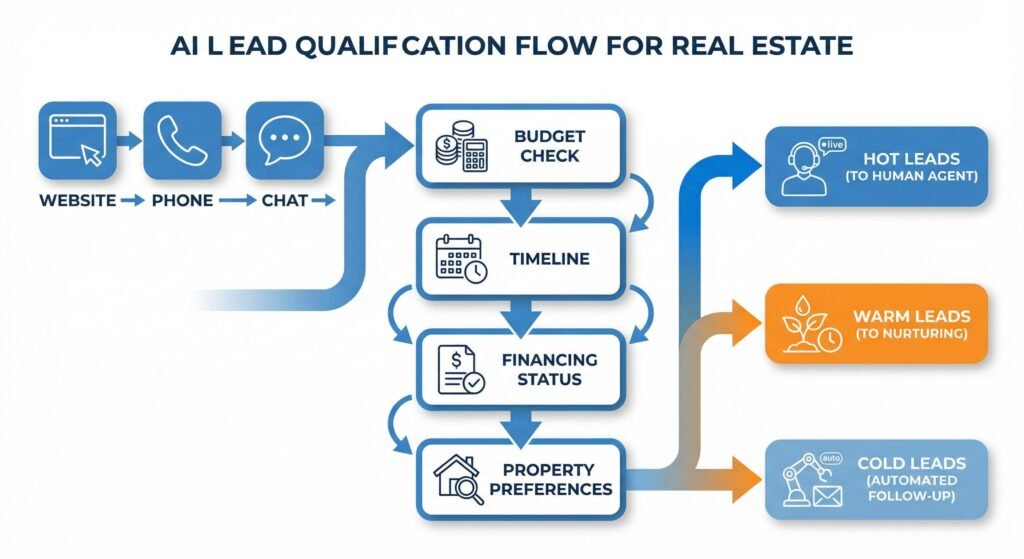
Instead of immediately sending every enquiry to a sales executive, an AI voice agent can make an initial conversation.
It could ask:
- What service are you interested in?
- What is your approximate budget?
- When would you like to start?
- Do you already have a website?
- Would you like a consultation?
The answers can then be sent to a CRM.
A qualified lead can be transferred to a salesperson, while less relevant enquiries can enter a nurturing workflow.
This can make AI voice agent open source technology valuable for agencies, service businesses, education companies, real-estate companies, healthcare administration and other organizations that receive regular enquiries.
AI Voice Agent Open Source for Customer Support
Customer support teams spend significant time answering repetitive questions.
An AI voice system can potentially handle common enquiries such as:
- Business hours
- Service information
- Order status
- Appointment information
- Basic troubleshooting
- Pricing information
- Location details
- Frequently asked questions
The important point is that automation should be designed around verified business information.
A voice agent should not be allowed to invent policies, prices or commitments.
For sensitive or complicated requests, the best workflow may be escalation to a human representative.
AI Voice Agent Open Source for Appointment Booking
Appointment management is another strong use case.
A customer might say:
“I want to book a consultation for Friday afternoon.”
The agent can understand the request and, when connected to an appropriate scheduling system, check availability.
It can then confirm the appointment and potentially send a confirmation message.
This type of automation can reduce repetitive administrative work while making the customer journey faster.
AI Voice Agent Open Source for Marketing Automation
Voice can become another channel inside a broader digital marketing system.
A company could combine:
Google Ads → Landing Page → Lead Form → CRM → AI Voice Agent → Qualification → Sales Team
or:
Social Media Campaign → Lead → Automated Call → Qualification → WhatsApp Follow-up
This approach connects marketing and communication automation instead of treating them as separate activities.
For businesses already investing in SEO, paid advertising and social media marketing, voice automation can become another layer in the customer acquisition funnel.
AI Voice Agent Open Source for Small and Medium Businesses
Large enterprises are not the only organizations that can benefit.
Small and medium businesses often receive many calls but have limited staff.
An AI voice agent open source solution can potentially help automate the first layer of communication.
For example, a local business could use a voice agent to answer basic questions, collect enquiry details and route important calls.
However, implementation should be proportional to business requirements.
A company receiving 20 calls per week may not need a highly complex infrastructure.
A business receiving thousands of calls may require a more advanced architecture with monitoring, queues, databases, telephony infrastructure and analytics.
How to Build an AI Voice Agent Open Source Solution
Building a voice agent requires more than simply connecting an LLM to a microphone.
A practical architecture generally includes the following stages.
Step 1: Define the Objective
Start with one specific business problem.
Examples:
- Answering FAQs
- Qualifying leads
- Booking appointments
- Customer support
- Call routing
Avoid trying to automate everything at the beginning.
Step 2: Choose the Voice Framework
Select an open-source framework based on:
- Programming language
- Community activity
- Documentation
- Integrations
- Licensing
- Telephony support
- Deployment options
Vocode, for example, describes Vocode Core as a modular open-source library for building voice-based LLM applications, with integrations for multiple speech synthesis services.
LiveKit Agents is another option for developers building realtime voice and multimodal applications.
Step 3: Select STT
Choose a speech-to-text technology based on:
- Accuracy
- Language support
- Streaming performance
- Cost
- Privacy requirements
Step 4: Select the LLM
The LLM should be selected according to the agent’s actual responsibilities.
A simple FAQ agent may not require the same model architecture as a complex multi-step customer-service agent.
Step 5: Select TTS
The voice needs to sound natural and understandable.
Important factors include:
- Voice quality
- Language
- Accent
- Latency
- Pricing
- Customization
Step 6: Create Business Rules
Define what the agent can and cannot do.
For example:
Can do:
Answer approved FAQs, collect lead information and schedule a consultation.
Cannot do:
Promise discounts, modify sensitive account information or provide unverified information.
Step 7: Connect Business Systems
Connect the agent with relevant APIs, CRM systems, calendars or databases.
Step 8: Test Real Conversations
Do not test only perfect questions.
Test:
- Interruptions
- Background noise
- Accents
- Unclear speech
- Multiple questions
- Angry customers
- Unexpected requests
- Silence
- Wrong information
Step 9: Add Human Handoff
A good AI voice agent open source implementation should have an escalation strategy.
If the AI cannot confidently help, transferring the conversation to a human may be the best outcome.
Step 10: Monitor and Improve
Review conversations and identify:
- Repeated failures
- Incorrect answers
- Long response times
- Customer drop-offs
- Unnecessary transfers
- Frequently asked questions
Use this information to improve the system continuously.
Important Challenges of AI Voice Agent Open Source
Although AI voice agent open source technology offers significant flexibility, it is not a magic solution.
Technical Complexity
Open-source does not automatically mean easy.
Developers may need to manage servers, APIs, authentication, databases, monitoring and deployment.
Voice Latency
Even a highly intelligent AI can provide a poor user experience if the response takes too long.
Model Costs
Open-source framework software may be free to use under its license, but the complete system may still involve costs for AI models, telephony, servers, storage and other infrastructure.
Security
Voice systems may process sensitive customer information.
Businesses should implement appropriate authentication, access controls, encryption, logging and data-handling practices.
Hallucinations
AI systems can sometimes generate incorrect information.
Businesses should use controlled knowledge sources, business rules and escalation mechanisms to reduce this risk.
Maintenance
AI ecosystems change quickly.
Models, APIs, libraries and dependencies need ongoing maintenance.
Therefore, the real cost of AI voice agent open source should be evaluated as the complete technology lifecycle rather than simply the software license.
What Makes a Good AI Voice Agent?
A successful voice agent is not necessarily the one with the most complicated technology.
It is the one that solves a real business problem effectively.
A good agent should:
- Understand customer intent
- Respond naturally
- Keep conversations focused
- Provide reliable information
- Handle interruptions
- Know when it cannot help
- Escalate appropriately
- Complete useful actions
- Protect customer information
- Work reliably at the required scale
The goal is not to make every conversation fully automated.
The goal is to make customer communication more efficient.
AI Voice Agent Open Source and the Future of Business Communication
Voice AI is moving from basic scripted automation toward more flexible conversational systems.
Modern frameworks increasingly support multimodal interactions, tool calling, realtime communication and integrations with different AI providers. LiveKit Agents, for example, supports voice, video and text interactions and provides tools for agent workflows and external data integration.
This means future voice agents may do much more than answer phone calls.
They may become intelligent interfaces for business systems.
A customer could say:
“Check my order, tell me when it will arrive and send the tracking link to WhatsApp.”
The agent could potentially understand the request, access the relevant business system and initiate multiple actions within one conversation.
This is where AI voice agent open source architecture becomes particularly interesting: developers can build the conversational layer around existing business systems instead of creating an isolated voice application.
How Digital Marketing India Can Help Businesses Explore AI Automation
Businesses interested in implementing voice automation need more than software.
They need a strategy connecting technology with marketing and customer acquisition.
Digital Marketing India, led by Saurabh Kumar with 15+ years of experience in digital marketing, provides digital solutions across website and app development, SEO, social media marketing, paid advertising, automation and communication solutions, creative services, video production, content marketing, analytics and online reputation management.
Its automation and communication services include WhatsApp marketing, bulk SMS marketing, voice call marketing, IVR and promotional calls, WhatsApp chatbot development, AI chatbot development, website live chat integration, marketing automation, CRM integration, email automation and lead nurturing automation.
For a business considering AI voice agent open source technology, these services can be part of a broader digital transformation strategy.

The objective should be to connect voice automation with the rest of the digital ecosystem rather than treating it as a standalone experiment.
A voice agent can work alongside:
- SEO
- Google Business Profile optimization
- Google Ads
- Meta Ads
- Landing pages
- CRM systems
- WhatsApp marketing
- Email automation
- Lead nurturing
- Analytics
This creates a more connected customer journey.
Final Thoughts on AI Voice Agent Open Source
The rise of AI voice agent open source technology is creating new opportunities for businesses that want more flexible and customizable voice automation.
Instead of depending entirely on rigid IVR menus, companies can explore conversational systems capable of understanding natural language, connecting with business tools and automating repetitive interactions.
Open-source frameworks can provide developers with flexibility over architecture, integrations and technology choices. Frameworks such as LiveKit Agents and Vocode demonstrate different approaches to building realtime or voice-based AI applications.
However, choosing AI voice agent open source technology should not be based solely on the fact that a framework is free or open source.
Businesses should evaluate the complete solution, including AI model costs, telephony, hosting, security, maintenance, scalability and human escalation.
The best implementation starts with a clearly defined business objective.
Whether the goal is lead qualification, customer support, appointment booking, call routing or marketing automation, a carefully designed voice agent can become a valuable part of a modern digital strategy.
For organizations planning to explore AI voice agent open source solutions, the right approach is to start small, measure results, improve the conversation flow and gradually connect the system with important business processes.
About Saurabh Kumar
Saurabh Kumar has 15+ years of experience in digital marketing and works across website and app development, SEO, social media marketing, paid advertising, automation, creative services, video production, content marketing, analytics and online reputation management.
Digital Marketing India
Official Address:
S15-00709, Vaidehi Niwas, Bhairomunna Link Road
Sahnewal, Ludhiana, Punjab – 141120
Contact: +91 76966 77728
Frequently Asked Questions
Is AI voice agent open source completely free?
Not necessarily. An open-source framework may be available under an open-source license, but businesses can still incur expenses for AI models, speech services, telephony, servers, monitoring and development.
Can AI voice agents make phone calls?
Yes, depending on the selected architecture and telephony integration. Frameworks such as LiveKit document telephony and SIP capabilities for realtime voice applications.
Can an AI voice agent connect with a CRM?
Yes. A voice agent can be designed to communicate with CRM systems through APIs or other supported integrations, allowing information collected during conversations to be stored or updated.
Is AI voice agent open source suitable for small businesses?
It can be, particularly when the use case is clearly defined. A small business can begin with a limited application such as FAQ handling or lead qualification and expand as requirements grow.
Can AI voice agents replace human employees?
They are better viewed as automation tools rather than universal replacements for people. Human representatives remain important for complex, sensitive or high-value interactions.
Which programming languages can be used?
This depends on the framework. LiveKit Agents currently provides SDKs for Python and Node.js, while different open-source voice projects may support different programming environments.
What is the first step toward implementing a voice agent?
The first step is to identify a specific business process that can benefit from voice automation. Once the objective is clear, the technology, models, integrations and deployment architecture can be selected accordingly.
Conclusion
AI voice agent open source technology represents an important development in conversational automation. With the right combination of speech recognition, language intelligence, voice synthesis, business logic and integrations, organizations can create voice experiences that are more flexible than traditional menu-based systems.
The technology is particularly valuable when implemented with a clear business objective. Start with a specific workflow, test real conversations, connect reliable business data and keep human escalation available.
For businesses looking to combine AI automation with SEO, paid advertising, social media, websites, CRM and digital marketing, a well-planned voice strategy can become another powerful channel for customer engagement and lead management.