Introduction
In a competitive digital marketplace, managing customer relationships efficiently is one of the biggest challenges for growing organizations. Enterprise CRM Software provides businesses with a centralized platform to organize customer information, streamline sales operations, automate communication, improve customer service, and make data-driven decisions. Unlike basic customer management tools, an enterprise-level CRM solution is designed to support complex workflows, multiple teams, large databases, different business locations, and thousands or even millions of customer interactions.
For organizations working across sales, marketing, customer support, operations, and management, disconnected systems can create delays and information gaps. Employees may maintain separate spreadsheets, communication histories, lead lists, and customer records. This makes it difficult to understand the complete customer journey. Enterprise CRM Software brings these activities together and creates a single source of reliable business information.
A well-planned CRM strategy can help companies improve productivity while delivering a more consistent customer experience. From lead generation and follow-ups to reporting and retention, a modern CRM platform can become an important part of an organization’s digital infrastructure.
Businesses looking for reliable digital transformation solutions can also combine CRM with website development, SEO, automation, advertising, communication tools, analytics, and other digital marketing services.
1. What Is Enterprise CRM Software?
Enterprise CRM Software is a customer relationship management platform created for large organizations with complex customer-management requirements. It enables companies to collect, organize, analyze, and use customer information across multiple departments and business functions.
A small CRM application may be sufficient for a startup with a handful of employees. However, larger organizations often require advanced permissions, multiple departments, automation workflows, integrations, analytics, security controls, customized dashboards, and scalable databases.
Enterprise CRM Software can bring together information such as:
- Customer names and contact details
- Lead sources
- Sales opportunities
- Previous purchases
- Customer conversations
- Email interactions
- Support requests
- Marketing responses
- Follow-up schedules
- Sales pipeline stages
- Customer preferences
- Revenue information
- Campaign performance
Instead of allowing information to remain scattered across different systems, an enterprise CRM creates a unified environment where authorized employees can access the information they need.
2. Why Enterprise CRM Software Is Important for Large Businesses
As an organization grows, customer management becomes increasingly complicated. More customers mean more conversations, more leads, more sales representatives, more support requests, and more data.
Enterprise CRM Software helps organizations control this complexity by establishing structured processes.
For example, when a potential customer submits an online inquiry, the CRM can automatically capture the lead. It can assign that lead to a salesperson, schedule a follow-up, send a confirmation message, and track subsequent interactions.
This reduces dependency on manual processes.
A centralized CRM system can also improve collaboration. Marketing teams can understand which campaigns generate qualified leads, sales teams can view customer history, and customer-support representatives can access relevant information without repeatedly asking customers to explain their previous interactions.
The result can be better internal coordination and a smoother customer experience.
For organizations operating across different cities, regions, branches, or countries, Enterprise CRM Software can provide a standardized approach to customer relationship management while allowing individual teams to follow relevant business processes.
3. Enterprise CRM Software for Sales Management
Sales teams depend heavily on accurate information and timely follow-ups. Missing a call, forgetting an appointment, or losing track of a prospect can directly affect revenue.
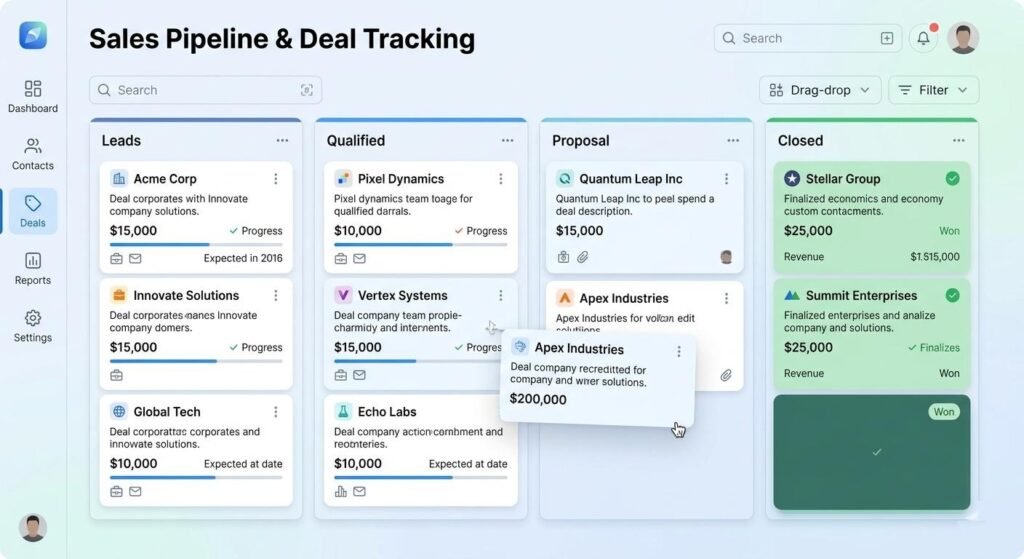
Enterprise CRM Software provides sales professionals with a structured system for managing the entire sales pipeline.
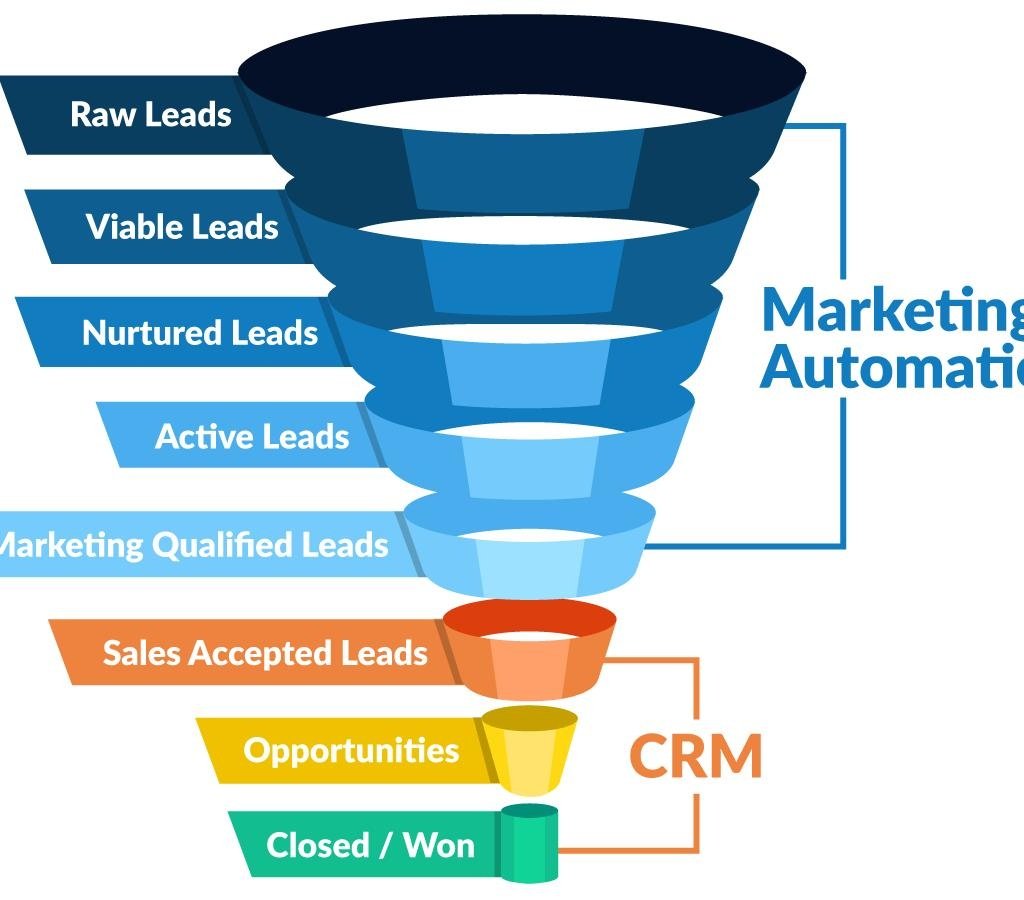
A typical sales process can include:
- Lead generation
- Lead qualification
- Initial communication
- Requirement analysis
- Product demonstration
- Proposal or quotation
- Negotiation
- Closing
- Customer onboarding
- Retention and upselling
CRM dashboards can display where every opportunity currently stands.
Sales managers can monitor team performance, identify stalled opportunities, compare conversion rates, and forecast potential revenue. Sales representatives can receive reminders for scheduled activities and maintain detailed records of their interactions.
With appropriate automation, routine administrative work can also be reduced, allowing sales professionals to spend more time communicating with prospects and customers.
4. Enterprise CRM Software for Marketing Automation
Marketing and sales teams need to work together if an organization wants to generate quality business opportunities. However, when customer data is fragmented, marketers may struggle to understand which prospects are ready for sales conversations.
Enterprise CRM Software can connect marketing activities with customer information and sales processes.
Businesses can use CRM systems to manage:
- Email campaigns
- Lead nurturing
- Customer segmentation
- Marketing automation
- Campaign tracking
- Lead scoring
- Retargeting workflows
- Follow-up sequences
- Customer lifecycle communication
For instance, a visitor may download a business guide from a website. The CRM can record the interaction and place the visitor into an appropriate nurturing campaign.
If that person later requests a product demonstration, the CRM can update their status and notify the sales team.
This connection between marketing activity and sales activity helps businesses create more relevant customer journeys.
5. Enterprise CRM Software for Customer Service
Customer experience has become an important differentiator for businesses. Customers expect fast responses, accurate information, and consistent support.
Enterprise CRM Software can give support teams access to a customer’s previous interactions, purchases, inquiries, complaints, and service history.
Instead of asking customers to repeat information, representatives can review the available history and respond more efficiently.
A CRM can also help organizations create support workflows. Customer requests can be categorized, prioritized, assigned to appropriate employees, and tracked until resolution.
Important customer-service features may include:
- Ticket management
- Complaint tracking
- Service history
- Automated notifications
- Knowledge-base integration
- Customer communication records
- Escalation workflows
- Support analytics
These capabilities can help businesses move from reactive customer service toward a more organized support experience.
6. Enterprise CRM Software and Business Automation
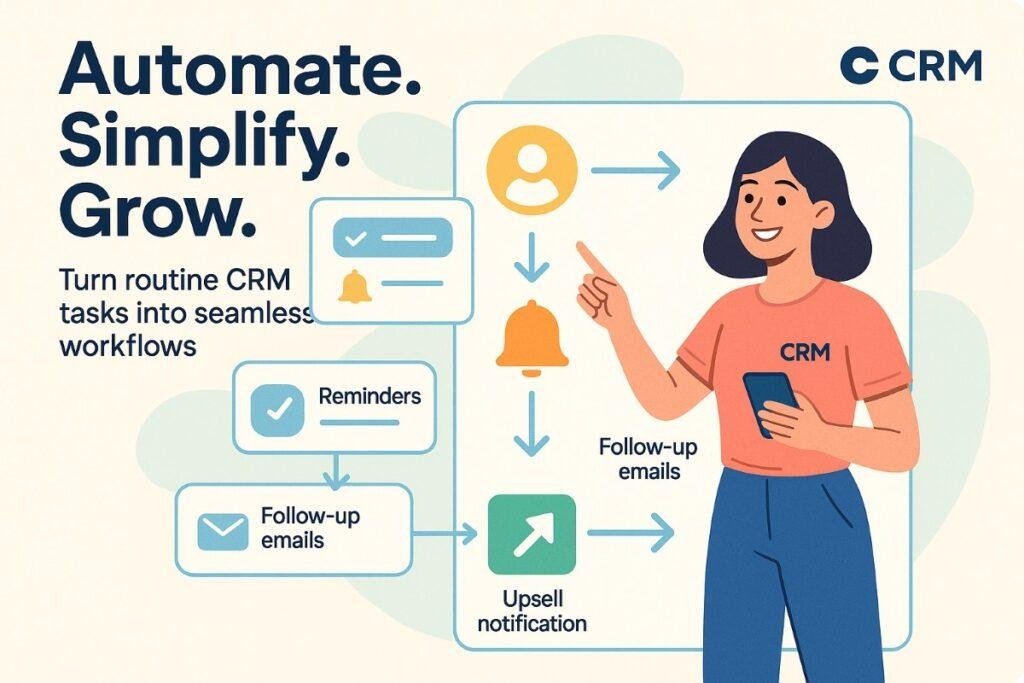
Manual repetitive tasks consume valuable employee time. Data entry, reminders, email notifications, lead assignments, status updates, and reporting can often be automated.
Enterprise CRM Software can act as the central engine for these workflows.
For example, a business can create a workflow in which a new website lead automatically enters the CRM. The system can then assign the lead according to location, product interest, department, or employee availability.
After assignment, an automated email or WhatsApp message can acknowledge the inquiry. A salesperson can receive a notification, while a follow-up task is automatically created.
Automation can also be used for inactive leads. If a prospect has not responded for a predefined period, the CRM can trigger a reminder or place the prospect into a nurturing sequence.
When carefully implemented, these workflows can reduce repetitive work and improve process consistency.
7. Enterprise CRM Software for Data-Driven Decision Making
Large organizations generate enormous amounts of information. However, data is valuable only when businesses can interpret and use it effectively.
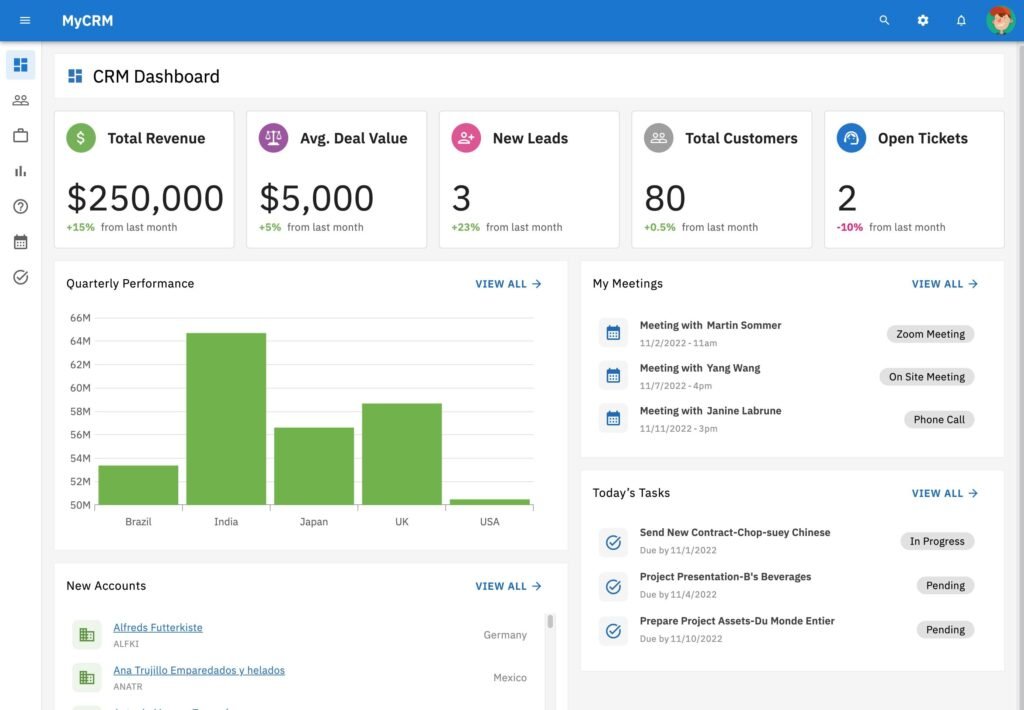
Enterprise CRM Software can transform customer and sales information into dashboards and reports that help management understand business performance.
Important metrics may include:
- Number of new leads
- Lead-to-customer conversion rate
- Sales pipeline value
- Average sales cycle
- Customer acquisition cost
- Customer retention
- Revenue by source
- Campaign performance
- Sales representative performance
- Customer lifetime value
Management can use these insights to identify opportunities and weaknesses.
For example, if a company discovers that one marketing channel generates a high volume of inquiries but very few qualified customers, its strategy can be adjusted.
Similarly, if a particular sales stage consistently causes delays, management can investigate the process and make improvements.
8. Enterprise CRM Software Integration With Digital Marketing
CRM should not operate as an isolated technology. Its value can increase significantly when connected with other digital marketing systems.
Enterprise CRM Software can potentially integrate with:
- Business websites
- E-commerce platforms
- Google Analytics
- Advertising platforms
- Email marketing systems
- WhatsApp communication
- SMS platforms
- Chatbots
- Payment systems
- Customer-support applications
- Marketing automation tools
Website forms can send leads directly into the CRM. Advertising campaigns can be connected with lead records. Email interactions can become part of customer histories.
For businesses investing in Google Ads, Meta Ads, SEO, social media marketing, and content marketing, CRM integration can help connect marketing activity with actual business outcomes.
Instead of measuring success only through clicks or impressions, companies can investigate which campaigns contribute to qualified leads, sales opportunities, and revenue.
9. Enterprise CRM Software for WhatsApp, SMS, and Communication
Communication is an essential part of modern customer relationship management. Customers increasingly expect businesses to respond through channels they already use.
Enterprise CRM Software can be integrated with communication solutions such as WhatsApp, SMS, email, voice calls, and website chat.
Businesses can use these channels for:
- Lead notifications
- Appointment reminders
- Order updates
- Promotional communication
- Customer support
- Follow-up messages
- Feedback requests
- Payment reminders
- Event invitations
A centralized communication history can make it easier for employees to understand what has already been communicated to a customer.
For example, if a sales representative sends a follow-up message through WhatsApp and another employee later contacts the same prospect, the CRM can help prevent unnecessary duplication.
Communication automation should always follow applicable privacy, consent, and messaging regulations.
10. Enterprise CRM Software for Lead Management
Generating leads is only one part of business growth. Organizations must also qualify, prioritize, follow up, and convert those leads.
Enterprise CRM Software can provide a structured lead-management framework.
Leads can be categorized according to:
- Industry
- Location
- Product interest
- Lead source
- Purchase intent
- Customer value
- Engagement level
- Previous interactions
Lead scoring can help sales teams prioritize prospects that demonstrate stronger buying signals.
For example, someone who visits multiple product pages, downloads information, submits an inquiry, and requests a consultation may deserve faster attention than someone who only visits a website once.
This type of structured lead management can reduce the chances of valuable opportunities being overlooked.
11. Enterprise CRM Software for Multi-Department Collaboration
In a large organization, customer information is rarely used by only one department.
Marketing may generate a lead. Sales may convert it. Finance may manage payments. Operations may deliver the service. Customer support may handle post-sale requirements.
Enterprise CRM Software can help these teams work around shared customer information.
A centralized platform can establish controlled access so employees see the information relevant to their roles.
For example:
- Marketing can view campaign performance.
- Sales can manage opportunities.
- Support can access service history.
- Managers can monitor performance.
- Executives can review business dashboards.
This reduces information silos and can create a more connected customer journey.
12. Enterprise CRM Software for Business Scalability
A CRM solution should not only solve today’s problems. It should also support tomorrow’s growth.
Enterprise CRM Software is particularly useful for organizations expecting expansion because it can accommodate increasing numbers of customers, employees, transactions, workflows, and communication records.
Scalability may involve:
- Additional users
- New branches
- New product categories
- New sales territories
- Additional integrations
- More automation
- Advanced reporting
- Customized workflows
As a business expands, its processes inevitably become more complex. A scalable CRM can provide the infrastructure required to manage this complexity without constantly rebuilding the entire system.
13. Enterprise CRM Software and Customer Retention
Acquiring a new customer can require considerable marketing and sales investment. Retaining existing customers is therefore an important business objective.
Enterprise CRM Software helps companies understand customer behavior and identify opportunities for engagement after the initial purchase.
Businesses can create customer-retention workflows involving:
- Follow-up communication
- Renewal reminders
- Feedback requests
- Loyalty campaigns
- Cross-selling
- Upselling
- Product recommendations
- Customer-support follow-ups
Customer history can also help representatives personalize conversations.
For example, if a customer has previously purchased a particular service, the business can use that information to recommend relevant upgrades or complementary services rather than sending completely unrelated promotions.
Personalization can make communication more meaningful and improve the overall relationship.
14. Enterprise CRM Software Security and Access Control
Large organizations handle sensitive business and customer information. Therefore, security must be an important consideration when selecting a CRM platform.
Enterprise CRM Software should support appropriate access controls, authentication methods, data-management practices, and permission structures.
Different employees may require different levels of access.
For example, a sales representative may need access to assigned customer records, while a senior manager may require broader reporting capabilities.
Organizations should also consider:
- User permissions
- Data backup
- Authentication
- Audit trails
- Encryption
- Compliance requirements
- Data retention policies
- Third-party integrations
The specific security capabilities required will depend on the organization’s industry, geography, regulations, and internal policies.
15. How to Choose Enterprise CRM Software for Your Business
Choosing Enterprise CRM Software requires more than comparing feature lists. Organizations should first understand their business processes and identify the problems they want the CRM to solve.
Important considerations include:
Business Requirements
Start by documenting existing sales, marketing, support, and operational workflows. Identify bottlenecks and repetitive activities.
Scalability
Choose a platform capable of supporting future users, customers, locations, integrations, and workflows.
Customization
Every organization operates differently. Custom fields, workflows, dashboards, permissions, and integrations may be necessary.
Integration
Check whether the CRM can connect with websites, advertising platforms, communication systems, accounting tools, e-commerce platforms, and other business applications.
Automation
Evaluate whether routine processes can be automated without creating unnecessary complexity.
Reporting
Look for dashboards and reports that provide actionable information rather than simply displaying large volumes of data.
User Experience
A powerful CRM is ineffective if employees find it difficult to use. Simplicity, training, and adoption should therefore be considered.
Security
Review authentication, permissions, backup, encryption, compliance, and other relevant security requirements.
Benefits of Implementing Enterprise CRM Software
A properly implemented Enterprise CRM Software platform can deliver benefits across multiple areas of an organization.
Better Customer Visibility
Employees can access relevant customer information from a centralized system.
Improved Productivity
Automation can reduce repetitive administrative tasks.
Faster Follow-Ups
Automated reminders and task management can help teams respond to opportunities on time.
Better Sales Management
Managers can monitor pipelines and sales performance more effectively.
Stronger Marketing Measurement
Marketing activities can be connected with leads and sales outcomes.
Improved Customer Experience
Support teams can access customer histories and provide more informed assistance.
Better Business Reporting
Management can use real-time or regularly updated information to evaluate performance.
Stronger Collaboration
Different departments can work with shared customer information while maintaining appropriate permissions.
Enterprise CRM Software and Digital Marketing India
For Indian businesses, CRM can become especially valuable when combined with a complete digital marketing strategy. Businesses today may receive leads from Google search, Google Business Profile, social media, Meta advertising, Google Ads, websites, WhatsApp, email campaigns, referrals, and offline marketing.
Without a centralized system, these leads can become difficult to track.
A connected digital ecosystem can help businesses bring marketing, communication, lead management, and reporting together.
Digital Marketing India, under the guidance of Saurabh Kumar, who has 15+ years of experience in digital marketing, provides digital solutions covering website and app development, SEO, social media marketing, paid advertising, automation, communication solutions, creative services, video production, content marketing, analytics, and online reputation management.
The objective is to help businesses create connected digital processes rather than treating every marketing activity as an independent service.
Businesses can combine CRM integration with:
- Website development
- E-commerce development
- Local SEO
- Google Business Profile optimization
- Google Ads
- Meta Ads
- Social media management
- WhatsApp marketing
- Bulk SMS
- IVR
- Chatbot development
- Marketing automation
- Email automation
- Lead nurturing
- Analytics
- Conversion tracking
- Reputation management
When these systems work together, businesses can create a more measurable and organized customer acquisition process.
Enterprise CRM Software With Website and App Development
A business website is often the first digital touchpoint between a company and its potential customers. Integrating the website with Enterprise CRM Software can automatically transfer customer inquiries into the organization’s sales system.
For example, website visitors can submit forms for:
- Product inquiries
- Service requests
- Demo bookings
- Consultations
- Quotations
- Support requests
- Newsletter subscriptions
Instead of manually copying information from emails or spreadsheets, the CRM can capture relevant information automatically.
For businesses requiring customized digital platforms, CRM integration can also be built into web applications and mobile applications.
Enterprise CRM Software and SEO
SEO generates organic visibility, but rankings and website traffic are not the final business objectives. Companies ultimately want qualified inquiries and customers.
Enterprise CRM Software can help businesses connect SEO-generated leads with their eventual outcomes.
For example, a company can identify:
- Which landing pages generate leads
- Which keywords attract high-value prospects
- Which organic visitors become customers
- Which locations generate better opportunities
- Which services receive the strongest demand
This data can help marketers refine their SEO strategy.
For local businesses, Google Business Profile optimization and local SEO can also be connected with lead tracking to create a clearer picture of how local search contributes to business growth.
Enterprise CRM Software and Paid Advertising
Paid advertising can generate significant numbers of leads, but businesses need to know what happens after someone submits an advertisement form.
Enterprise CRM Software can help track the journey from advertisement interaction to lead, opportunity, and customer.
This enables businesses to compare campaigns based on more meaningful outcomes.
For example, one campaign might produce 500 leads while another produces only 150. However, if the second campaign generates substantially more customers, it may be more valuable.
CRM data can therefore support smarter advertising decisions by connecting lead quality with campaign performance.
Enterprise CRM Software and Analytics
Analytics provides visibility into what is happening across digital channels. CRM adds information about what happens after a lead enters the business.
Together, these systems can provide deeper insight.
Businesses can analyze:
- Traffic sources
- Lead sources
- Conversion rates
- Sales outcomes
- Customer acquisition
- Revenue contribution
- Campaign effectiveness
- Customer retention
This approach allows organizations to move from surface-level marketing metrics toward business-focused performance measurement.
Common Mistakes When Implementing Enterprise CRM Software
Even a sophisticated CRM platform can fail if implementation is poorly planned.
One common mistake is selecting software before understanding business requirements.
Another is trying to automate every process immediately. Automation should simplify operations rather than reproduce inefficient processes at a faster speed.
Other mistakes include:
- Poor employee training
- Incomplete data migration
- Lack of management involvement
- Too many unnecessary customizations
- Weak data-cleaning practices
- Ignoring user feedback
- Lack of integration planning
- No clear CRM strategy
- Measuring activity instead of outcomes
Successful implementation usually requires planning, testing, employee training, ongoing optimization, and clear ownership.
Conclusion
Enterprise CRM Software can become a powerful foundation for managing customer relationships, sales operations, marketing activities, communication, automation, and business intelligence. For organizations handling large customer databases and multiple departments, a centralized CRM can replace disconnected processes with a more structured and measurable system.
The real value of Enterprise CRM Software does not come simply from purchasing a platform. It comes from implementing the right workflows, integrating relevant business systems, training employees, maintaining accurate data, and continuously improving processes.
When CRM is connected with website development, SEO, Google Business Profile optimization, social media marketing, paid advertising, WhatsApp communication, chatbots, automation, analytics, and reputation management, businesses can build a connected digital ecosystem designed around the customer journey.
For organizations planning digital transformation, the right CRM strategy can improve visibility, strengthen collaboration, reduce repetitive work, support better decision-making, and create a more consistent customer experience.
Digital Marketing India – Services
Saurabh Kumar
15+ Years of Experience in Digital Marketing
🌐 Website & App Development
Business Website Development, E-Commerce Website Development, Custom Web Applications, Mobile App Development for Android & iOS, Landing Page Development, Website Maintenance & Support.
🔍 SEO Services
Local SEO, On-Page SEO, Off-Page SEO, Technical SEO, E-Commerce SEO, Google Business Profile Optimization, SEO Audit & Competitor Analysis.
📱 Social Media Marketing
Facebook Marketing, Instagram Marketing, LinkedIn Marketing, YouTube Marketing, Social Media Management, Content Creation & Strategy.
🎯 Paid Advertising
Meta Ads, Google Ads, YouTube Ads, LinkedIn Ads, Remarketing Campaigns, Lead Generation Campaigns.
🤖 Automation & Communication Solutions
WhatsApp Marketing, Bulk SMS Marketing, Voice Call Marketing, IVR, WhatsApp Chatbot Development, AI Chatbot Development, Website Live Chat Integration, Marketing Automation, CRM Integration, Email Marketing Automation, Lead Nurturing Automation.
🎨 Creative Services
Graphic Designing, Social Media Creatives, Logo Design, Banner & Brochure Design, Brand Identity Design.
🎬 Video Production
Video Editing, Reels Editing, YouTube Video Editing, Corporate Videos, Motion Graphics, Promotional Videos.
✍️ Content Marketing
Content Writing, Blog Writing, Website Content Writing, SEO Content Writing, Ad Copywriting.
📊 Analytics & Reporting
Google Analytics Setup, Conversion Tracking, Performance Reports, ROI Analysis.
⭐ Online Reputation Management
Google Review Management, Brand Monitoring, Online Reputation Building.
Contact Digital Marketing India
Name: Saurabh Kumar
Experience: 15+ Years in Digital Marketing
Official Address: S15-00709, Vaidehi Niwas, Bhairomunna Link Road, Sahnewal, Ludhiana, Punjab – 141120
Contact: +91 76966 77728