

Introduction
Learning how to analyse Sarvatobhadra Chakra can add a deeper dimension to the study of Vedic astrology. For students and practitioners, understanding how to analyse Sarvatobhadra Chakra provides a structured way to examine planetary influences, Nakshatras, Rashis, Tithis and weekdays together. Unlike a conventional horoscope reading, how to analyse Sarvatobhadra Chakra focuses on the relationship between several sensitive astrological points.
For beginners, learning how to analyse Sarvatobhadra Chakra may seem difficult because the Chakra contains different Nakshatras, letters, numbers, Rashis, Tithis and other references. However, once the basic structure is understood, how to analyse Sarvatobhadra Chakra becomes much easier to follow. The technique can help astrologers study planetary movements and their possible influence on specific points.
An important part of how to analyse Sarvatobhadra Chakra is understanding the concept of Vedha. Vedha refers to a planetary influence or interaction with another significant point in the Chakra. Therefore, anyone learning how to analyse Sarvatobhadra Chakra should understand how planets create such influences and how those influences are interpreted.
The process of how to analyse Sarvatobhadra Chakra generally begins with identifying the relevant Nakshatra or other sensitive point. The astrologer then examines the associated planetary influence and considers the nature and strength of the planet. A proper approach to how to analyse Sarvatobhadra Chakra also involves comparing these indications with the birth chart and planetary transits.
Studying how to analyse Sarvatobhadra Chakra should not be limited to one factor. The best understanding comes from combining Nakshatra, Rashi, Tithi, Vara and planetary influences. This makes how to analyse Sarvatobhadra Chakra a useful supplementary technique for advanced astrological study.
It is important to remember that how to analyse Sarvatobhadra Chakra can vary slightly across different traditional schools. Therefore, practitioners should study authentic sources and apply the technique consistently. Ultimately, how to analyse Sarvatobhadra Chakra is a skill developed through proper learning, observation and regular practice.
1. What Is Sarvatobhadra Chakra?
Before understanding how to analyse Sarvatobhadra Chakra, it is important to understand what the Chakra actually represents.
Sarvatobhadra Chakra is a traditional Vedic astrology technique that uses a specific grid or chart to study the influence of planets on different astrological points. The word “Sarvatobhadra” can broadly be understood as something that considers influences from different directions or aspects.
The Chakra generally incorporates:
- 28 Nakshatra positions
- Rashis
- Tithis
- Weekdays or Varas
- Certain Sanskrit vowels and consonants
- Other sensitive points used in traditional calculations
One of its important applications is Vedha analysis. When a planet occupies or influences a particular position in the Chakra, it may create an effect on another connected point.
This technique is particularly useful when an astrologer wants to investigate the influence of transiting planets over specific Nakshatras or other sensitive points.
2. Understand the Structure Before Learning How to Analyse Sarvatobhadra Chakra
The first practical step in how to analyse Sarvatobhadra Chakra is learning the structure of the Chakra.
The traditional Chakra is arranged in a square pattern containing different astrological references. These references are not randomly placed. Their arrangement allows an astrologer to identify relationships between different elements.
The major components include:
Nakshatras
The Nakshatras are among the most important elements. The 27 commonly used Nakshatras, along with Abhijit in certain traditional applications, form the foundation of the Chakra.
Rashis
The twelve zodiac signs are also incorporated into the Chakra. They provide another reference point for understanding planetary influence.
Tithi
Tithi represents the lunar day and is another important factor used in the traditional system.
Vara
Vara represents the weekday, such as Sunday, Monday, Tuesday and so on.
Letters
Specific Sanskrit vowels and consonants are placed within the Chakra. These can become relevant when analysing names, sounds or other sensitive points according to the tradition being followed.
Understanding this basic layout is essential before attempting detailed interpretation.
3. Identify the Relevant Nakshatra When Learning How to Analyse Sarvatobhadra Chakra
One of the most important steps in how to analyse Sarvatobhadra Chakra is identifying the relevant Nakshatra.
The Nakshatra can be determined from the Moon’s position in a birth chart, depending on the purpose of the analysis. For transit-based analysis, the astrologer may also consider the Nakshatra occupied by the transiting planet.
For example, if the Moon is placed in a particular Nakshatra, that Nakshatra becomes an important reference point for interpretation.
The astrologer can then examine:
- Which planets are influencing the Nakshatra
- Whether a planet is producing Vedha
- Whether benefic or challenging planets are involved
- Whether multiple planets are influencing the same area
- Whether the influence is temporary or connected with a significant period
The Nakshatra should not be analysed alone. Its relationship with the other components of the Chakra is what makes this system useful.
4. Understand Vedha to Learn How to Analyse Sarvatobhadra Chakra
If you want to understand how to analyse Sarvatobhadra Chakra properly, Vedha is one of the most important concepts to learn.
Vedha refers to an influence or obstruction created by a planetary position in relation to another sensitive point in the Chakra.
In practical terms, an astrologer identifies a planet’s position and then checks which corresponding points are affected according to the Sarvatobhadra Chakra arrangement.
The nature of the result depends on several factors, including:
- The planet involved
- Its natural nature
- Its functional role in the horoscope
- The point receiving the Vedha
- The strength of the planet
- Other simultaneous planetary influences
- The overall horoscope
This means Vedha should not automatically be interpreted as positive or negative without considering the complete context.
A planet creating influence on a particular Nakshatra may produce different results depending on the horoscope and the purpose of the analysis.
5. Analyse Planetary Transits Using Sarvatobhadra Chakra
Another important part of how to analyse Sarvatobhadra Chakra is studying planetary transits.
Transit analysis involves observing where planets are currently moving and checking their relationship with the sensitive points represented in the Chakra.
For example, an astrologer may examine the transit of:
- Sun
- Moon
- Mars
- Mercury
- Jupiter
- Venus
- Saturn
- Rahu
- Ketu
Each planet can create a different type of influence.
Fast-moving planets may create relatively short-term effects, while slower-moving planets such as Jupiter and Saturn can remain connected with particular areas for longer periods.
When several planets influence the same sensitive point, the astrologer may consider the combined effect rather than interpreting each planet separately.
6. Check the Rashi and Tithi in Sarvatobhadra Chakra Analysis
A complete approach to how to analyse Sarvatobhadra Chakra should not focus only on Nakshatras.
Rashi and Tithi are also important references.
The Rashi provides the zodiacal background for the analysis. If a planet creates influence on a Rashi-related point, the astrologer can investigate whether that influence connects with important areas of the horoscope.
Tithi provides a lunar-day reference and can add another layer to the interpretation.
For example, if a particular transit simultaneously connects with:
- A sensitive Nakshatra
- A relevant Rashi
- A significant Tithi
the astrologer may consider the combination more important than any individual factor.
This layered approach is one of the reasons Sarvatobhadra Chakra can be useful for advanced astrological analysis.
7. Study Weekdays and Letters in Sarvatobhadra Chakra
When studying how to analyse Sarvatobhadra Chakra, beginners sometimes overlook weekdays and letters.
However, these elements form part of the traditional structure of the Chakra.
The weekdays, or Varas, are associated with planetary rulers. Therefore, the weekday component can provide another reference when studying planetary influence.
The letters placed in the Chakra are also significant in traditional applications. Depending on the school of astrology, astrologers may use them while examining names, sounds or other relevant identifiers.
This is why simply looking at planetary positions is not enough. A proper analysis requires understanding how the different components are positioned and connected.
8. How to Analyse Sarvatobhadra Chakra for Planetary Influence
Once the basic structure is understood, the next stage in how to analyse Sarvatobhadra Chakra is identifying the planet and tracing its influence.
A practical sequence can be:
Step 1: Prepare the birth chart or transit chart.
Step 2: Identify the relevant Nakshatra, Rashi, Tithi or other sensitive point.
Step 3: Locate the corresponding point in the Sarvatobhadra Chakra.
Step 4: Identify the planets occupying or influencing the relevant positions.
Step 5: Check the applicable Vedha relationships.
Step 6: Assess whether the influencing planets are naturally benefic or malefic.
Step 7: Compare the result with the main horoscope.
This systematic approach reduces confusion and makes interpretation more organised.
9. How to Analyse Sarvatobhadra Chakra During Important Transits
Sarvatobhadra Chakra can also be studied during important planetary transits.
Slow-moving planets are particularly interesting for transit analysis because their influence can remain relevant for a longer duration.
For example, astrologers may examine major movements of:
- Saturn
- Jupiter
- Rahu
- Ketu
They may then compare the transit positions with the relevant Nakshatras, Rashis and other points in the Chakra.
The purpose is not simply to label a transit as good or bad. Instead, the astrologer attempts to understand which areas may receive stronger planetary influence and when that influence becomes more relevant.
For better accuracy, the transit analysis should be combined with the Dasha system, natal planetary placements and other established principles.
10. How to Analyse Sarvatobhadra Chakra for Events
Another practical application of how to analyse Sarvatobhadra Chakra is event-oriented astrology.
Depending on the tradition and purpose, astrologers may use it to investigate periods associated with:
- Career developments
- Important decisions
- Travel
- Financial changes
- Relationships
- Public recognition
- Challenges
- Major life transitions
However, Sarvatobhadra Chakra should not be treated as a standalone event-prediction system.
A stronger interpretation comes from comparing the Chakra with the birth horoscope and relevant planetary periods.
For instance, if the Chakra indicates strong planetary influence during a particular period and the natal chart and Dasha also support a similar theme, the astrologer may consider the indication more significant.
11. Common Mistakes While Learning How to Analyse Sarvatobhadra Chakra
People learning how to analyse Sarvatobhadra Chakra often make a few common mistakes.
Looking at only one planet
A single planetary influence does not always tell the complete story. Multiple factors should be examined.
Ignoring the natal chart
The Sarvatobhadra Chakra should generally be used as a supplementary tool rather than replacing the birth chart.
Treating every Vedha as negative
Vedha does not automatically mean something bad. The planet, context and affected point must be considered.
Ignoring planetary strength
A strong planet and a weak planet may not produce identical results.
Making absolute predictions
Astrology involves interpretation. Statements such as “this event will definitely happen” should be avoided when the technique is being used without sufficient supporting factors.
Ignoring timing
Transit analysis becomes much more useful when combined with appropriate timing techniques.
12. How to Analyse Sarvatobhadra Chakra More Accurately
For anyone serious about how to analyse Sarvatobhadra Chakra, accuracy comes from combining traditional principles rather than relying on one indicator.
A useful analytical framework is:
Birth Chart + Dasha + Transit + Sarvatobhadra Chakra + Relevant Astrological Factors
Start with the natal horoscope and identify the fundamental planetary promises. Then examine the running Dasha or relevant timing technique. After that, study current planetary transits.
Sarvatobhadra Chakra can then be used as an additional layer to identify specific planetary influences.
This approach helps prevent overinterpretation.
It is also important to use a consistent traditional reference because different teachers and schools may explain certain technical details differently.
Pandit Raghava Bhatt – Vedic Astrology & 55 Vidyas Expert
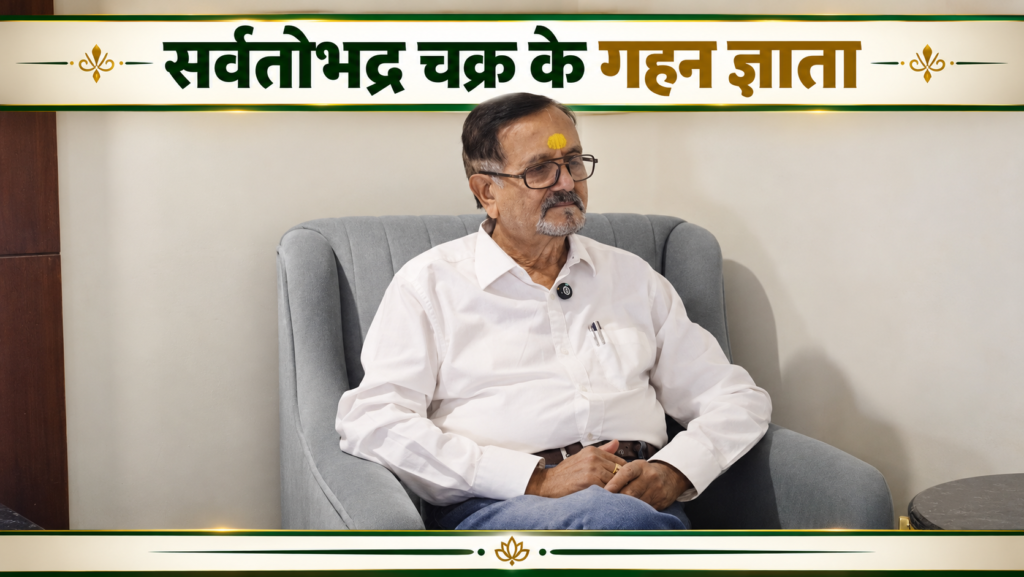
Pandit Raghava Bhatt is known for his knowledge and work in Vedic Astrology, Jyotish and traditional spiritual sciences. With a deep interest in ancient Indian knowledge systems, he focuses on sharing astrological concepts in a simple, practical and easy-to-understand manner. His areas of knowledge include Vedic Astrology, Nakshatra-based analysis, Sarvatobhadra Chakra, Ramal Astrology and other specialised astrological techniques. He also shares his understanding of the 55 Vidyas through educational discussions, consultations, podcasts and digital content. His approach focuses on helping people understand astrology beyond basic horoscope reading by explaining planetary influences, Nakshatras, transits and different predictive techniques in a structured way. Through his content and interactions, Pandit Raghava Bhatt aims to make traditional astrological knowledge more accessible to today’s audience while maintaining its traditional essence. Along with his astrology and spiritual work, his digital presence and social media activities are being managed in collaboration with Digital Marketing India. Together, they are working on his social media presence, content strategy, creative content and digital branding to reach a wider audience and present his knowledge effectively across digital platforms. This collaboration combines traditional astrological knowledge with modern digital marketing strategies, helping his educational content connect with people who are interested in Astrology, Jyotish, spirituality and ancient Indian sciences. Through this combined effort, Pandit Raghava Bhatt continues to share valuable knowledge while Digital Marketing India supports the growth and management of his digital and social media presence.

Practical Example of Sarvatobhadra Chakra Analysis
Suppose an astrologer wants to examine a particular period in a person’s life.
The first step would be to identify the relevant planetary period from the horoscope. Next, the astrologer studies the current planetary transits.
Suppose Saturn is transiting through a Nakshatra that is important for the native. The astrologer can locate that Nakshatra in the Sarvatobhadra Chakra and examine the associated Vedha relationships.
The astrologer can then ask:
- Which point is receiving the influence?
- Which planet is responsible?
- Is the planet naturally benefic or malefic?
- What is the planet’s role in the birth chart?
- Is the same theme supported by the Dasha?
- Are other planets creating additional influence?
- Does the natal horoscope support the predicted area of life?
Only after answering these questions should a conclusion be formed.
This demonstrates why how to analyse Sarvatobhadra Chakra is less about memorising one rule and more about learning a systematic process.
Learn Sarvatobhadra Chakra with Expert Guidance
If you want to learn Sarvatobhadra Chakra in depth, Dr. Raghava Bhatt provides guidance and teaches this specialised technique of Vedic Astrology in a simple and practical way. To learn more about Sarvatobhadra Chakra and connect for guidance, call Digital Marketing India at +91 76966 77728.
Benefits of Learning Sarvatobhadra Chakra
There are several reasons advanced astrology students study this technique.
Additional Layer of Analysis
It provides another perspective beyond the conventional birth chart.
Transit Analysis
It can help astrologers organise planetary transit influences.
Nakshatra-Based Study
It gives greater importance to Nakshatra relationships.
Structured Interpretation
The Chakra provides a visual framework that can make complex relationships easier to study.
Advanced Astrology Practice
For students who already understand basic Vedic astrology, learning this technique can expand their analytical toolkit.
Saurabh Kumar – Founder & Director of Digital Marketing India
Saurabh Kumar is the Founder and Director of Digital Marketing India, with 15+ years of experience in the digital marketing industry. He works with businesses, professionals and brands to build their online presence and achieve sustainable digital growth. His expertise covers SEO, Social Media Marketing, Google Business Profile Optimization, PPC Advertising, Website & App Development, Content Marketing, Graphic Designing and Video Marketing. Through Digital Marketing India, Saurabh Kumar focuses on creating practical and result-oriented digital strategies based on each client’s business goals and target audience. His approach combines creative content, search engine optimization, social media management, paid advertising and modern digital tools to help brands improve visibility, generate leads and strengthen their online identity. Over the years, he has worked across different industries and continues to help businesses adapt to the changing digital landscape. Along with managing Digital Marketing India, Saurabh Kumar is also actively involved in content strategy, brand building and digital growth initiatives. His objective is to make digital marketing simple, effective and accessible for businesses looking to establish a stronger presence in the online world.

Final Thoughts
Understanding how to analyse Sarvatobhadra Chakra requires patience, practice and a strong foundation in Vedic astrology. Beginners should first understand the structure of the Chakra, followed by Nakshatras, Rashis, Tithis, Varas, letters and the concept of Vedha.
The most important lesson is that Sarvatobhadra Chakra should not be interpreted in isolation. Its indications become more meaningful when compared with the natal chart, planetary periods, transits and other relevant astrological principles.
With regular practice, an astrologer can gradually become more comfortable identifying planetary influences and understanding how different sensitive points interact.
Whether you are an astrology student, researcher or practicing astrologer, Sarvatobhadra Chakra can be studied as a valuable traditional technique for deeper horoscope analysis.
About the Author
Saurabh Kumar
15+ Years of Experience in Digital Marketing
Saurabh Kumar is a digital marketing professional with extensive experience in SEO, website development, social media marketing, paid advertising, content marketing, video production and marketing automation.
Digital Marketing India provides end-to-end digital marketing and technology solutions for businesses looking to build visibility, generate leads and strengthen their online presence.
Our Services
Website & App Development: Business websites, e-commerce websites, custom web applications, mobile apps, landing pages and website maintenance.
SEO Services: Local SEO, On-Page SEO, Off-Page SEO, Technical SEO, E-Commerce SEO, Google Business Profile Optimization, SEO audits and competitor analysis.
Social Media Marketing: Facebook, Instagram, LinkedIn and YouTube marketing, social media management and content strategy.
Paid Advertising: Meta Ads, Google Ads, YouTube Ads, LinkedIn Ads, remarketing and lead generation campaigns.
Automation & Communication: WhatsApp marketing, Bulk SMS, voice call marketing, WhatsApp chatbots, AI chatbots, live chat, CRM integration and marketing automation.
Creative Services: Graphic designing, social media creatives, logo design, banners, brochures and brand identity.
Video Production: Video editing, Reels editing, YouTube editing, corporate videos, motion graphics and promotional videos.
Content Marketing: Content writing, blog writing, website content, SEO content and ad copywriting.
Analytics & Reporting: Google Analytics setup, conversion tracking, performance reports and ROI analysis.
Online Reputation Management: Google review management, brand monitoring and online reputation building.
Official Address:
S15-00709, Vaidehi Niwas, Bhairomunna Link Road
Sahnewal, Ludhiana, Punjab – 141120
Contact: +91 76966 77728