
Introduction
If you want to learn Sarvatobhadra Chakra, you are exploring one of the fascinating Nakshatra-based techniques of Vedic astrology. Unlike a conventional birth chart that primarily focuses on planets, houses and zodiac signs, Sarvatobhadra Chakra brings together Nakshatras, Rashis, Tithis, weekdays and name-related syllables in a structured 9 × 9 grid. The technique is particularly associated with transit analysis and the concept of Vedha, or planetary influence on specific points of the Chakra.
The word Sarvatobhadra is generally understood through Sarva meaning “all” and Bhadra meaning “auspicious” or “good.” The system is traditionally connected with Nakshatra-based predictive astrology and includes 28 Nakshatras, with Abhijit included alongside the commonly used 27 Nakshatras.
For students of Vedic astrology, learning this Chakra can add another dimension to horoscope interpretation, especially when studying planetary transits, Muhurta and event timing.
1. What Is Sarvatobhadra Chakra?
To learn Sarvatobhadra Chakra properly, the first step is understanding its basic structure.
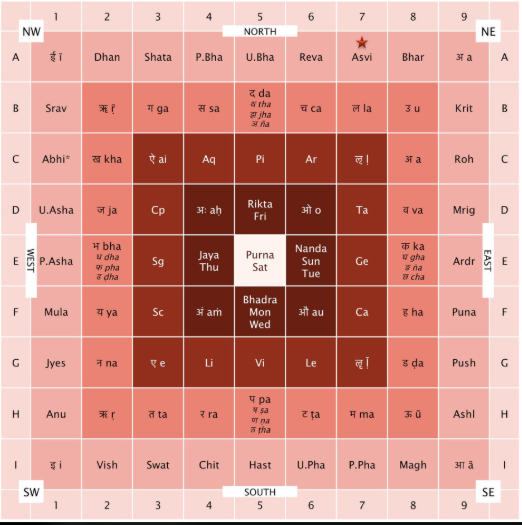
Sarvatobhadra Chakra is traditionally represented as a 9 × 9 square containing 81 divisions. Different traditions and explanatory sources describe the internal arrangement somewhat differently, but the central principle remains the same: several important astrological factors are brought together in one diagram so that planetary influences can be examined through the concept of Vedha.
The Chakra incorporates:
- 28 Nakshatras
- 12 Rashis
- Tithi groups
- Weekdays
- Sanskrit vowels and consonants or name-related Aksharas
- Planetary positions for transit analysis
This makes the Sarvatobhadra Chakra particularly interesting because it does not look at a single astrological factor in isolation.
Instead, it creates a framework where different points can be examined together.
For someone beginning to learn Sarvatobhadra Chakra, it is useful to think of the system as a specialised astrological map. A planet occupying a particular Nakshatra can create Vedha toward other points represented within the Chakra.
2. Why Learn Sarvatobhadra Chakra in Vedic Astrology?
Why should an astrology student learn Sarvatobhadra Chakra when there are already so many techniques available?
The answer lies in its specialised approach to Nakshatra-based transit analysis.
Sarvatobhadra is considered an additional tool rather than a replacement for the complete birth chart. It can be used alongside horoscope analysis, Dasha systems and other traditional techniques to understand possible influences during particular periods. Saravali describes it as useful for Gochara, or transit predictions, and as an additional tool for chart and Dasha analysis.
Some commonly discussed applications include:
- Studying planetary transits
- Examining Nakshatra-based influences
- Understanding Vedha
- Supporting Muhurta analysis
- Examining name syllables
- Comparing planetary movements with important birth points
- Adding another layer to event timing
However, it is important not to treat the Chakra as a standalone guarantee of an event. Astrological interpretation should consider the complete horoscope and the relevant techniques together.
3. Learn Sarvatobhadra Chakra Through Its 9 × 9 Structure
One of the most important steps when you learn Sarvatobhadra Chakra is becoming comfortable with its 81-cell structure.
The traditional diagram consists of a square divided into 81 smaller sections. The outer area is associated with the Nakshatras, while inner sections accommodate other astrological factors such as Rashis, Tithi classifications and Aksharas.
The outer ring is particularly important because it accommodates the 28 Nakshatras, including Abhijit.
A commonly described arrangement begins with Krittika and proceeds around the Chakra. Abhijit occupies a special position between Uttarashada and Shravana in traditions that use the 28-Nakshatra framework.
The remaining sections provide a framework for connecting:
Nakshatra → Rashi → Tithi → Vara → Akshara
This is one reason the Chakra can initially appear complicated.
The key is not to memorise everything at once.
Start by understanding the layout. Then learn how planets are placed. Finally, study how Vedha operates.
4. Learn Sarvatobhadra Chakra and the 28 Nakshatras
The Nakshatras form the foundation of the technique. Therefore, anyone who wants to learn Sarvatobhadra Chakra should first have a good understanding of the 27 commonly used Nakshatras and the additional Abhijit Nakshatra used in this system.
The Nakshatras are lunar divisions used extensively in Vedic astrology. In Sarvatobhadra Chakra, they occupy the outer portion of the grid.
The 28-Nakshatra framework includes:
- Ashwini
- Bharani
- Krittika
- Rohini
- Mrigashira
- Ardra
- Punarvasu
- Pushya
- Ashlesha
- Magha
- Purva Phalguni
- Uttara Phalguni
- Hasta
- Chitra
- Swati
- Vishakha
- Anuradha
- Jyeshtha
- Mula
- Purva Ashadha
- Uttara Ashadha
- Abhijit
- Shravana
- Dhanishta
- Shatabhisha
- Purva Bhadrapada
- Uttara Bhadrapada
- Revati
Abhijit is particularly important because it is not normally counted among the 27 Nakshatras used in many modern horoscope calculations. Its inclusion is one of the distinctive features of this technique.
5. Learn Sarvatobhadra Chakra Through Vedha
If there is one concept you must understand when you learn Sarvatobhadra Chakra, it is Vedha.
Vedha can broadly be understood as an influence, piercing or obstruction created by a planetary position toward another point in the Chakra.
A planet placed in a particular Nakshatra does not remain isolated. According to the traditional Sarvatobhadra framework, its position creates lines of influence toward other locations in the Chakra. Sources describe these as straight and diagonal lines or specific Vedha relationships.
For example, when a planet occupies a Nakshatra on the outer ring, its Vedha can connect with another Nakshatra or with relevant internal points depending on the traditional rules being followed.
This is where the Chakra becomes useful for transit interpretation.
Instead of simply asking:
“Where is Saturn transiting?”
the astrologer can also ask:
“Which Nakshatra is Saturn occupying, and which important birth points does its Vedha influence?”
That creates a more specialised Nakshatra-based approach to transit analysis.
6. Learn Sarvatobhadra Chakra for Planetary Transit Analysis
Another major reason to learn Sarvatobhadra Chakra is its application in planetary transit studies.
Planets continuously move through different signs and Nakshatras. In Vedic astrology, these movements are commonly studied to understand changing influences.
Sarvatobhadra adds another framework to this process.
The astrologer can place the relevant planetary positions on the Chakra and then examine their Vedha relationships with important points.
Depending on the method being followed, these points may include:
- Janma Nakshatra
- Moon sign
- Name syllable
- Relevant Tithi classification
- Weekday
- Other significant Chakra positions
Some modern Sarvatobhadra calculators similarly allow natal and transit planetary positions to be plotted against the 9 × 9 framework.
The objective is not simply to label every transit as positive or negative.
Instead, the astrologer studies which areas are being influenced and then compares that information with the complete horoscope.
7. Learn Sarvatobhadra Chakra Using Tithi and Vara
When you learn Sarvatobhadra Chakra, you will encounter the five traditional Tithi groups:
- Nanda
- Bhadra
- Jaya
- Rikta
- Purna
The 30 lunar Tithis are organised into these five categories. Sources commonly describe the grouping as:
Nanda: 1, 6, 11
Bhadra: 2, 7, 12
Jaya: 3, 8, 13
Rikta: 4, 9, 14
Purna: 5, 10, 15
The exact presentation of weekdays alongside these groups can vary by traditional layout, but one commonly described association places Sunday and Tuesday with Nanda, Monday and Wednesday with Bhadra, Thursday with Jaya, Friday with Rikta and Saturday with Purna.
Understanding this classification helps students recognise how the daily Panchanga elements are incorporated into Sarvatobhadra analysis.
This is particularly relevant when the technique is used for Muhurta or timing-related interpretation.
8. Learn Sarvatobhadra Chakra and Name Akshara
An interesting feature that makes people want to learn Sarvatobhadra Chakra is the inclusion of letters or Aksharas.
Traditional layouts incorporate Sanskrit vowels and consonants into the Chakra. This allows an individual’s name-related starting sound or letter to become another point of reference during interpretation.
For example, an astrologer may consider:
Birth Nakshatra + Moon Sign + Name Akshara + Transit Planet
The purpose is to examine whether planetary Vedha is influencing the relevant point
9. Learn Sarvatobhadra Chakra for Muhurta
Those who learn Sarvatobhadra Chakra often explore its use in Muhurta, the traditional discipline of selecting an appropriate time for an activity.
The basic idea is to examine whether the selected moment is receiving favourable or unfavourable influences according to the applicable Chakra rules.
Possible areas of application can include:
- Starting a business activity
- Important meetings
- Travel
- Ceremonial occasions
- Launches
- Other significant events
A Sarvatobhadra assessment should not be considered independently. Panchanga factors, planetary strength, the person’s horoscope and the purpose of the event may all need consideration.
Some modern explanations specifically describe Sarvatobhadra as a tool for judging whether a particular moment is favourable for an individual or event.
This makes it especially interesting for students who want to go beyond basic horoscope reading.
10. Learn Sarvatobhadra Chakra Step by Step
If you are serious about learning the technique, do not try to memorise the entire Chakra in one day.
A practical learning sequence is:
Step 1: Learn the Nakshatras
Memorise all 27 standard Nakshatras and understand the position of Abhijit.
Step 2: Understand the 9 × 9 Grid
Study where Nakshatras, Rashis, Tithis and Aksharas are positioned.
Step 3: Understand the Five Tithi Groups
Learn Nanda, Bhadra, Jaya, Rikta and Purna.
Step 4: Learn Planetary Placement
Understand how Sun, Moon, Mars, Mercury, Jupiter, Venus, Saturn, Rahu and Ketu are placed according to their Nakshatra positions.
Step 5: Study Vedha
This is the heart of Sarvatobhadra interpretation.
Step 6: Start With One Planet
Instead of analysing nine planets simultaneously, choose one transit planet and observe its Vedha.
Step 7: Compare With Janma Nakshatra
Study how the transit affects the person’s birth Nakshatra.
Step 8: Add Moon Sign and Name Akshara
Gradually introduce additional reference points.
Step 9: Compare With the Birth Chart
Never isolate Sarvatobhadra from the main horoscope.
Step 10: Practise With Real Examples
Take historical or sample charts and compare the Chakra interpretation with known events.
This step-by-step method makes it much easier to learn Sarvatobhadra Chakra without becoming overwhelmed by the number of rules.
11. Learn Sarvatobhadra Chakra Without Making Common Mistakes
While you learn Sarvatobhadra Chakra, beginners often make a few common mistakes.
Trying to memorise everything immediately
The Chakra contains many components. First understand the structure and logic before memorising every relationship.
Treating every Vedha as an event
A Vedha is an astrological influence within the system. It should not automatically be interpreted as a guaranteed event.
Ignoring the birth chart
Sarvatobhadra is best treated as an additional analytical technique rather than a complete substitute for horoscope analysis.
Using incorrect birth details
Accurate birth date, time and place can be important for calculating Nakshatra and other horoscope factors.
Mixing different traditions
Different practitioners and modern tools may present certain Sarvatobhadra rules differently. For serious study, follow one established methodology consistently.
Making absolute predictions
Astrology involves interpretation. A responsible reading should avoid presenting symbolic indications as guaranteed outcomes.
How Long Does It Take to Learn Sarvatobhadra Chakra?
The time required to learn Sarvatobhadra Chakra depends on your existing knowledge of Vedic astrology.
If you already understand Nakshatras, Rashis, Tithis, planetary transits and basic horoscope interpretation, you can understand the fundamental structure relatively quickly.
However, becoming proficient requires practice.
A useful learning plan could look like this:
Week 1:
Understand the Chakra structure and 28 Nakshatras.
Week 2:
Study Rashis, Tithis, Vara and Aksharas.
Week 3:
Study Vedha rules and planetary placement.
Week 4:
Practise transit analysis using sample horoscopes.
After the first month, continue practising with different charts and events. The objective should not simply be memorisation. You should learn how the different components interact.
Why Sarvatobhadra Chakra Is Different From a Normal Kundli
A normal Kundli gives a broad picture of planetary positions through signs, houses, aspects, Dashas and other important factors.
Sarvatobhadra Chakra approaches astrology from another angle.
It gives greater emphasis to Nakshatra-based relationships and Vedha.
This makes the two systems complementary rather than necessarily competing.
For example, a horoscope may show a particular planetary period, while Sarvatobhadra may provide an additional way of examining transit influences during that period.
For advanced astrology students, combining multiple techniques can provide a more structured interpretation—provided each technique is applied correctly.
Practical Example of Sarvatobhadra Chakra Learning
Suppose an astrologer wants to study the effect of a major planetary transit on an individual.
The process may begin by identifying the person’s:
- Birth Nakshatra
- Moon sign
- Relevant name Akshara
- Birth-related Tithi classification
The astrologer then identifies the transit planet’s current Nakshatra.
Next, the applicable Vedha relationships are examined.
If the planetary influence reaches the person’s important Chakra point, the astrologer notes the indication.
The next step is crucial: the result should be compared with the person’s complete horoscope, current Dasha and other relevant transit conditions.
This example demonstrates why it is better to learn Sarvatobhadra Chakra as part of a broader Vedic astrology education rather than treating it as a standalone prediction machine.
Frequently Asked Questions About Sarvatobhadra Chakra
Is Sarvatobhadra Chakra difficult to learn?
The basic structure can be learned with regular practice. The more challenging part is understanding and applying Vedha rules correctly.
Does Sarvatobhadra Chakra use 27 or 28 Nakshatras?
The traditional Sarvatobhadra framework commonly uses 28 Nakshatras by including Abhijit.
What is Vedha in Sarvatobhadra Chakra?
Vedha refers to the planetary piercing or influence between designated positions in the Chakra. It is one of the most important concepts used in interpretation.
Can beginners learn Sarvatobhadra Chakra?
Yes. Beginners can start with the 9 × 9 structure, Nakshatras and basic Vedha before moving to more advanced applications.
Is Sarvatobhadra Chakra enough to predict the future?
It should not be treated as a standalone system that guarantees specific outcomes. It is better understood as an additional Vedic astrology technique.
Is Sarvatobhadra Chakra useful for transit analysis?
Yes. Transit and Gochara analysis are among its important traditional applications.
About Dr. Raghava S. Bhatt

Dr. Raghava S. Bhatt is a renowned Indian Vedic astrologer, Vastu consultant, numerologist and gemologist with decades of experience in Vedic sciences. He specialises in Vedic Astrology, KP Astrology, Nadi Astrology, Vastu Shastra, Numerology, Tarot Reading, Gemology and Matchmaking. His expertise includes Kundli analysis, planetary influences, Nakshatra-based astrology, Sarvatobhadra Chakra, numerology techniques, Vastu principles and various traditional methods of astrological interpretation. Along with providing consultations, Dr. Raghava S. Bhatt also guides and teaches people who wish to understand and learn different aspects of Vedic astrology and related sciences in a structured and practical manner. His approach focuses on helping learners understand the fundamentals as well as advanced concepts of astrology so that they can develop a deeper understanding of these traditional systems. He is associated with Digital Marketing India, where his knowledge, expertise and educational initiatives are being promoted through digital platforms to reach a wider audience. Through this association, people interested in learning astrology and related subjects can get information about his courses, learning opportunities and consultations.
Learn from Dr. Raghava S. Bhatt
If you wish to learn from Dr. Raghava S. Bhatt about Vedic Astrology, Sarvatobhadra Chakra, KP Astrology, Nadi Astrology, Numerology, Vastu Shastra, Tarot Reading or other Vedic sciences, you can contact Saurabh Kumar, Digital Marketing India. Our team will guide you with the relevant information and help you connect regarding learning and consultation opportunities.
Contact: Saurabh Kumar – Digital Marketing India
Phone: +91 76966 77728
About Saurabh Kumar
Saurabh Kumar has 15+ years of experience in Digital Marketing and works across SEO, website development, social media marketing, paid advertising, content marketing, automation and online reputation management.

Official Address:
S15-00709, Vaidehi Niwas, Bhairomunna Link Road
Sahnewal, Ludhiana, Punjab – 141120
Contact: +91 76966 77728
Digital Marketing India – Services
Website & App Development: Business Websites, E-Commerce Websites, Custom Web Applications, Android & iOS Apps, Landing Pages, Website Maintenance & Support.
SEO Services: Local SEO, On-Page SEO, Off-Page SEO, Technical SEO, E-Commerce SEO, Google Business Profile Optimization, SEO Audits & Competitor Analysis.
Social Media Marketing: Facebook, Instagram, LinkedIn & YouTube Marketing, Social Media Management, Content Creation & Strategy.
Paid Advertising: Meta Ads, Google Ads, YouTube Ads, LinkedIn Ads, Remarketing & Lead Generation Campaigns.
Automation & Communication: WhatsApp Marketing, Bulk SMS, Voice Call Marketing, WhatsApp Chatbots, AI Chatbots, Live Chat, CRM Integration, Email Automation & Lead Nurturing.
Creative Services: Graphic Designing, Social Media Creatives, Logo Design, Banners, Brochures & Brand Identity.
Video Production: Video Editing, Reels Editing, YouTube Videos, Corporate Videos, Motion Graphics & Promotional Videos.
Content Marketing: Content Writing, Blog Writing, Website Content, SEO Content & Ad Copywriting.
Analytics & Reporting: Google Analytics, Conversion Tracking, Performance Reports & ROI Analysis.
Online Reputation Management: Google Review Management, Brand Monitoring & Online Reputation Building.