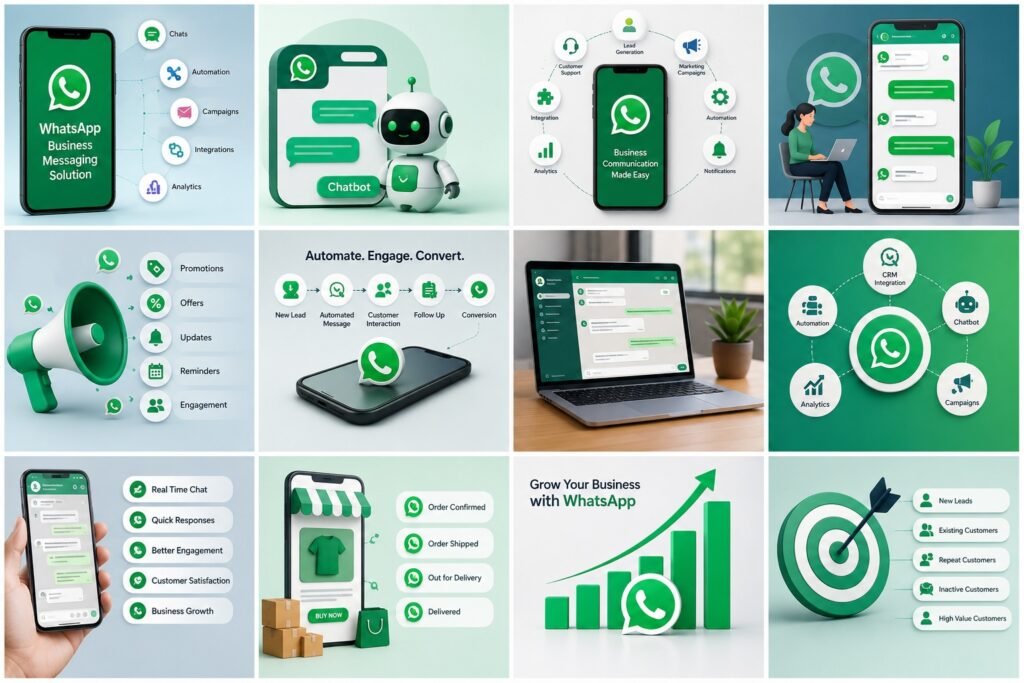
In today’s digital-first business environment, customers expect brands to respond quickly, communicate conveniently, and provide information through channels they already use every day. A WhatsApp Business Messaging Solution gives businesses a practical way to connect with prospects and existing customers, automate conversations, share updates, generate leads, provide support, and build stronger customer relationships through WhatsApp.
For businesses of all sizes, communication is no longer simply about sending promotional messages. Customers want immediate answers, personalized interactions, order updates, appointment reminders, product information, support, and follow-ups. When these activities are managed manually, businesses can lose valuable time and potential customers.
A properly planned WhatsApp Business Messaging Solution can bring these communication activities together into a more organized and scalable system. From marketing campaigns and automated responses to chatbots, CRM integration, and lead nurturing, WhatsApp can become an important part of a company’s digital communication strategy.
Businesses can also combine WhatsApp communication with other digital marketing services such as SEO, social media marketing, paid advertising, website development, content marketing, and marketing automation to create a complete customer acquisition and retention ecosystem.
What Is a WhatsApp Business Messaging Solution?
A WhatsApp Business Messaging Solution is a business communication system that enables companies to interact with customers through WhatsApp in a structured, professional, and scalable manner.
Instead of relying only on individuals to manually answer every WhatsApp conversation, businesses can use automation, templates, chatbots, customer databases, CRM integrations, and campaign management tools to improve communication.
The objective is not simply to send more messages. The objective is to send the right message to the right customer at the right stage of the customer journey.
For example, a business can use WhatsApp to:
- Respond to new enquiries
- Share product or service information
- Send appointment confirmations
- Provide order updates
- Follow up with leads
- Send reminders
- Answer frequently asked questions
- Share promotional offers
- Collect customer information
- Provide customer support
- Re-engage inactive customers
- Nurture potential buyers
- Connect conversations with CRM systems
This makes a WhatsApp Business Messaging Solution particularly useful for businesses that receive a large number of customer enquiries and want to improve their response time.
Why Businesses Need a WhatsApp Business Messaging Solution
Traditional communication methods such as phone calls and emails still have value, but customers increasingly prefer quick, convenient, conversational communication.
Imagine a potential customer visits a website at 9:00 PM and wants to ask about a service. If the only option is to fill out a form and wait for a callback, that customer may contact another company instead.
With a WhatsApp Business Messaging Solution, the same customer can start a conversation immediately.
This can reduce communication friction and make it easier for businesses to move prospects from interest to enquiry and eventually to conversion.
Another major advantage is the conversational nature of WhatsApp. Customers can ask questions, receive answers, share documents, send images, and continue conversations without moving between multiple communication channels.
For sales teams, this can make lead follow-up considerably easier.
For customer service teams, it can provide a familiar environment for resolving problems.
For marketing teams, it can create another channel for engaging with interested audiences.
For management, automation and reporting can provide better visibility into communication performance.
1. How a WhatsApp Business Messaging Solution Improves Lead Generation
Lead generation is one of the most important applications of a WhatsApp Business Messaging Solution.
Businesses spend significant amounts of money and effort generating traffic through Google Ads, Meta Ads, SEO, social media, websites, and other marketing channels. However, generating a lead is only the beginning.
The next challenge is responding quickly.
When a prospect submits an enquiry, delays can reduce the likelihood of conversion. A WhatsApp-based communication process can help businesses respond immediately or initiate an automated conversation.
For example, an advertisement can encourage a potential customer to start a WhatsApp conversation. Once the customer enters the chat, an automated flow can ask useful qualifying questions such as:
- What service are you interested in?
- What is your preferred location?
- When would you like to start?
- What type of requirement do you have?
- Would you like a callback?
The answers can then be passed to the sales team.
This creates a smoother transition between advertising and sales.
A WhatsApp Business Messaging Solution can therefore help businesses reduce lead response delays and organize conversations more effectively.
2. WhatsApp Business Messaging Solution for Automated Customer Support
Customer support is another area where WhatsApp automation can deliver significant value.
Businesses often receive repetitive questions about pricing, availability, working hours, locations, services, booking procedures, delivery information, and payment options.
Answering these questions manually every time consumes employee resources.
A WhatsApp Business Messaging Solution can automate responses to frequently asked questions while still allowing customers to connect with a human representative whenever necessary.
For example, a customer could type “services” and receive a menu containing:
- Website Development
- SEO Services
- Social Media Marketing
- Google Ads
- WhatsApp Marketing
- Chatbot Development
- Contact Sales
The customer can select an option and receive relevant information.
This type of structured conversation can make customer support faster and more consistent.
Automation does not mean removing humans from customer service. Instead, it allows employees to focus on conversations that genuinely require human attention.
3. Using WhatsApp Business Messaging Solution for Marketing Campaigns
WhatsApp can also become an effective communication channel for marketing campaigns when used strategically and responsibly.
A WhatsApp Business Messaging Solution can help businesses communicate with customers about relevant products, services, announcements, events, offers, launches, and other updates.
However, effective WhatsApp marketing is not about sending the same message to everyone.
Segmentation is essential.
A company could divide its audience into categories such as:
- New leads
- Existing customers
- Repeat customers
- High-value customers
- Inactive customers
- Customers interested in specific services
- Customers who requested a quotation
- Customers who abandoned an enquiry
Each group can receive more relevant communication.
For example, someone who has already purchased a product may not need the same introductory message as a new prospect.
Personalization and relevance can improve the overall customer experience.
Businesses should also follow applicable WhatsApp policies, consent requirements, and communication regulations when conducting messaging campaigns.
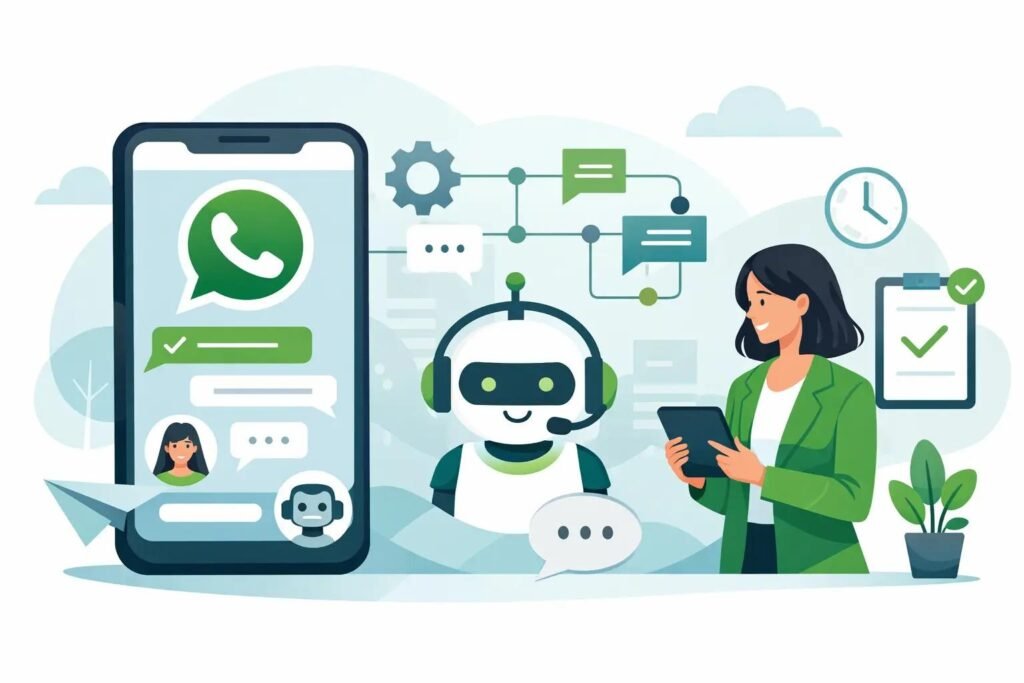
4. WhatsApp Business Messaging Solution for Lead Nurturing
Not every lead is ready to purchase immediately.
Some prospects may need additional information before making a decision. Others may compare multiple companies, discuss the purchase internally, or simply need more time.
This is where lead nurturing becomes important.
A WhatsApp Business Messaging Solution can support a structured follow-up process.
For example:
Day 1: Thank the customer for the enquiry.
Day 2: Share useful information about the service.
Day 4: Answer common questions or share a relevant case study.
Day 7: Follow up regarding the customer’s requirement.
Day 10: Offer an opportunity to speak with a representative.
The exact sequence should depend on the business, audience, product, and buying cycle.
The key advantage is consistency.
Sales representatives no longer have to remember every follow-up manually. Automated workflows can help ensure that interested prospects do not disappear simply because someone forgot to call them.
A good WhatsApp Business Messaging Solution can therefore work as an extension of the sales team.
5. WhatsApp Business Messaging Solution and CRM Integration
Customer data becomes increasingly valuable as a business grows.
If conversations are stored separately from customer information, sales teams may struggle to understand the complete customer journey.
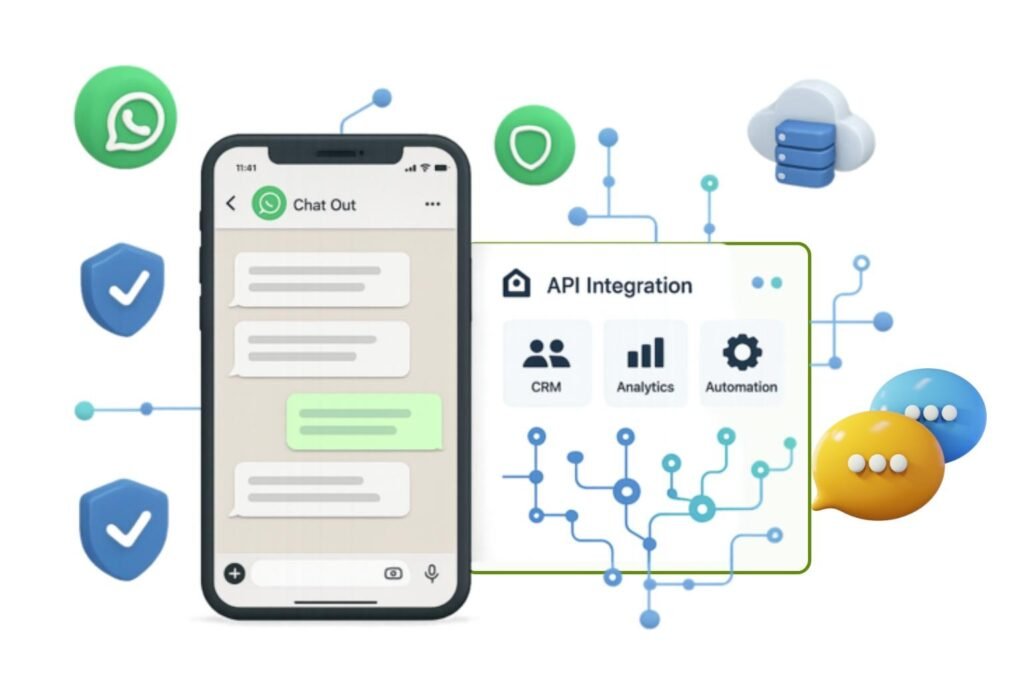
Integrating WhatsApp with a CRM can help connect conversations with lead records.
For example, when a customer contacts a company through WhatsApp, the system can potentially capture information such as:
- Customer name
- Contact details
- Enquiry source
- Service interest
- Conversation history
- Sales status
- Follow-up requirements
- Assigned salesperson
This can provide sales teams with greater context before they communicate with the customer.
A WhatsApp Business Messaging Solution combined with CRM integration can also help businesses create clearer sales pipelines.
Instead of treating every WhatsApp conversation as an isolated chat, companies can view communication as part of a broader customer journey.
This becomes especially useful for organizations with multiple sales representatives or large volumes of enquiries.
6. WhatsApp Business Messaging Solution for Appointment and Reminder Automation
Appointment-based businesses can benefit significantly from automated WhatsApp communication.
Businesses such as clinics, consultants, salons, educational institutions, service providers, repair companies, and professional agencies often need to send appointment-related notifications.
A WhatsApp Business Messaging Solution can help automate messages such as:
- Appointment confirmation
- Appointment reminder
- Rescheduling information
- Cancellation notification
- Follow-up message
- Service completion message
- Feedback request
For example, instead of relying on a staff member to call every customer before an appointment, an automated reminder can be sent through WhatsApp.
This can reduce administrative workload and make communication more convenient for customers.
The same approach can be adapted for online meetings, consultations, demonstrations, classes, service visits, and other scheduled activities.
7. WhatsApp Business Messaging Solution for E-Commerce Businesses
E-commerce businesses manage large numbers of customer interactions every day.
Customers may want to know:
- Is my order confirmed?
- Has my order been shipped?
- Where is my package?
- Can I change my address?
- How can I return the product?
- What payment options are available?
- When will my order arrive?
A WhatsApp Business Messaging Solution can help businesses provide these updates through automated communication workflows.
Instead of forcing customers to repeatedly check an external website, businesses can send relevant notifications directly through WhatsApp.
WhatsApp can also support product discovery and customer engagement, depending on the business’s technology setup and available WhatsApp capabilities.
For e-commerce brands, the goal should be to make communication simple while keeping customers informed throughout the purchasing journey.
8. WhatsApp Business Messaging Solution for Chatbot Development
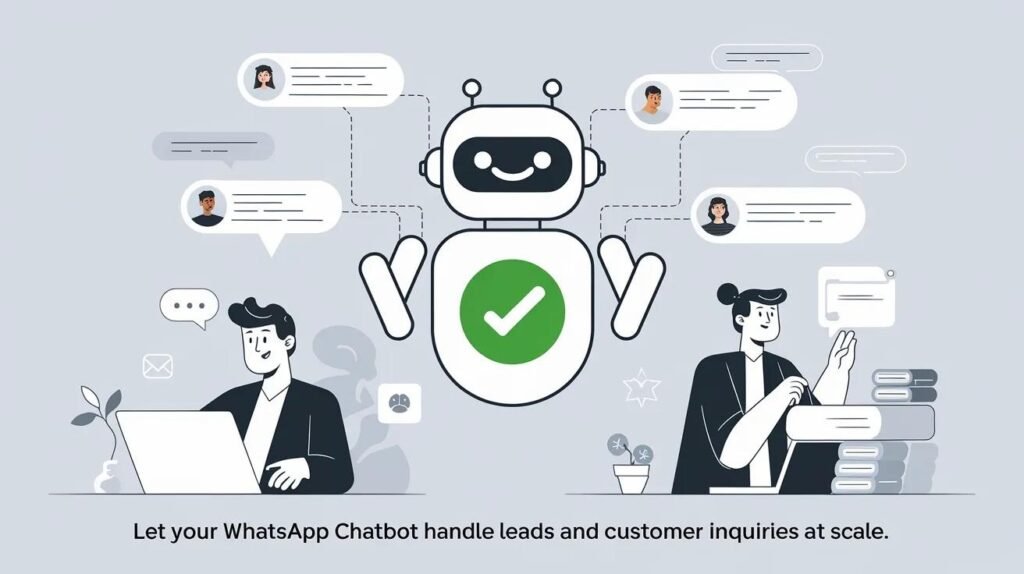
A WhatsApp chatbot can handle predefined conversations automatically and help businesses manage a high volume of enquiries.
For example, a customer may type:
“SEO”
The chatbot can respond:
“Sure. Which SEO service are you interested in?”
The customer may select:
- Local SEO
- Technical SEO
- E-Commerce SEO
- Google Business Profile Optimization
- SEO Audit
The chatbot can then provide relevant information or connect the customer with a sales representative.
An advanced WhatsApp Business Messaging Solution can also be combined with AI chatbot technology to make conversations more flexible.
AI-powered systems can help understand natural-language questions and provide appropriate responses based on available business information.
However, businesses should carefully design chatbot conversations. A chatbot should make communication easier rather than creating unnecessary complexity.
There should also be a clear option for customers to reach a human representative when required.
9. Measuring Performance with WhatsApp Business Messaging Solution
Marketing without measurement makes it difficult to understand what is actually working.
A WhatsApp Business Messaging Solution can become more valuable when communication performance is tracked.
Depending on the technology and integration used, businesses may monitor metrics such as:
- Number of conversations
- Leads generated
- Response rates
- Message delivery
- Customer engagement
- Follow-up activity
- Conversion rates
- Sales generated
- Campaign performance
- Customer response patterns
These insights can help businesses improve their communication strategy.
For example, if a particular campaign generates many conversations but very few qualified leads, the business may need to improve its targeting or message.
If customers frequently ask the same question, that information can be used to improve chatbot responses or website content.
Data can therefore turn WhatsApp from a simple communication tool into a measurable component of a broader digital marketing strategy.
10. Combining WhatsApp Business Messaging Solution with Digital Marketing
WhatsApp works best when it is connected with the rest of a company’s marketing ecosystem.
For example, a business can use SEO to attract organic traffic, Google Ads to generate high-intent visitors, social media marketing to build awareness, and WhatsApp communication to handle enquiries.
A potential customer might discover a business through Google.
They visit the website.
They click the WhatsApp button.
They ask a question.
An automated system provides initial information.
The lead is added to the CRM.
A salesperson follows up.
The customer purchases.
After the purchase, WhatsApp is used for support and feedback.
This creates a connected customer journey.
At Digital Marketing India, businesses can combine a WhatsApp Business Messaging Solution with services such as website development, SEO, Google Business Profile optimization, social media marketing, paid advertising, content marketing, CRM integration, and marketing automation.
The result is a more integrated digital marketing strategy instead of treating every marketing channel separately.
Key Benefits of a WhatsApp Business Messaging Solution
Businesses considering WhatsApp automation should evaluate the practical benefits it can deliver.
Faster Communication
Customers receive information quickly, which can improve the overall experience.
Better Lead Management
Incoming enquiries can be organized, qualified, and routed to the appropriate team.
Reduced Manual Work
Automated responses and workflows can handle repetitive communication.
Improved Follow-Ups
Businesses can create structured follow-up processes rather than relying entirely on manual reminders.
Personalized Communication
Messages can be adapted according to customer interests, journey stage, or previous interactions.
Scalable Customer Support
Automation can help businesses handle larger communication volumes without increasing manual workload at the same rate.
Better Customer Experience
Customers can communicate through a familiar messaging platform instead of navigating complicated systems.
Integration Opportunities
WhatsApp can be connected with websites, CRM systems, chatbots, lead forms, and marketing automation platforms depending on the technology implementation.
Who Can Benefit from a WhatsApp Business Messaging Solution?
Almost any business that communicates regularly with customers can explore WhatsApp-based communication.
Some examples include:
Real Estate: Property enquiries, site-visit coordination, lead follow-ups, and appointment scheduling.
Healthcare: Appointment reminders, confirmations, and general administrative communication, subject to applicable privacy and regulatory requirements.
Education: Course enquiries, admission communication, reminders, and student updates.
E-Commerce: Order notifications, customer support, product communication, and feedback.
Hospitality: Booking enquiries, confirmations, reminders, and guest communication.
Professional Services: Lead qualification, consultation scheduling, document requests, and follow-ups.
Automotive: Service reminders, booking communication, enquiry management, and customer updates.
Retail: Product enquiries, offers, customer support, and repeat engagement.
Digital Agencies: Lead generation, client communication, service enquiries, follow-ups, and support.
For each industry, the communication workflow should be customized around customer needs rather than using a generic automation template.
WhatsApp Business Messaging Solution vs. Traditional Communication
Traditional communication channels still have their place. Phone calls can be valuable for complex conversations, while email remains useful for formal documents and detailed communication.
WhatsApp provides another layer of convenience.
A phone call requires both parties to be available simultaneously.
An email can sometimes feel slow for simple questions.
WhatsApp offers a conversational middle ground where customers can communicate asynchronously while still receiving quick responses.
This is particularly useful for modern consumers who prefer messaging over waiting on calls.
However, businesses should not attempt to replace every communication channel with WhatsApp.
The strongest strategy is often an omnichannel approach, where WhatsApp works alongside websites, email, phone calls, social media, search engines, and CRM systems.
How to Choose the Right WhatsApp Business Messaging Solution
Not every business needs the same level of WhatsApp automation.
A small business with a limited number of enquiries may need basic automation and organized customer communication.
A growing company may require CRM integration, lead routing, chatbot functionality, reporting, and automated workflows.
Before selecting a solution, businesses should consider:
1. Business Objective
Identify whether the primary goal is lead generation, support, sales, notifications, marketing, or automation.
2. Message Volume
Understand how many customer conversations the business handles every day.
3. Automation Requirements
Determine which repetitive tasks should be automated.
4. CRM Requirements
Check whether WhatsApp communication needs to connect with an existing CRM.
5. Chatbot Requirements
Determine whether basic menus are sufficient or whether advanced AI-based conversations are required.
6. Reporting
Identify which performance metrics need to be tracked.
7. Scalability
Choose a system that can support future business growth.
8. Compliance
Ensure communication practices follow applicable WhatsApp policies, privacy requirements, consent expectations, and relevant regulations.
The right solution should simplify communication rather than add unnecessary complexity.
Why Professional Implementation Matters
Technology alone does not guarantee better marketing results.
A poorly designed WhatsApp campaign can overwhelm customers with irrelevant messages, while a well-planned system can create meaningful conversations.
Professional implementation involves more than connecting a WhatsApp account.
It requires understanding:
- Customer journeys
- Lead sources
- Sales processes
- Audience segmentation
- Message content
- Automation workflows
- Follow-up timing
- CRM integration
- Conversion tracking
- Customer support processes
At Digital Marketing India, the focus can extend beyond individual WhatsApp campaigns to the complete digital marketing ecosystem.
With 15+ years of digital marketing experience, Saurabh Kumar works across website development, SEO, social media marketing, paid advertising, WhatsApp marketing, chatbot development, automation, content marketing, creative services, video production, analytics, and online reputation management.
This integrated approach can help businesses connect their marketing activities instead of managing every channel independently.
Digital Marketing India – Complete Digital Marketing Services
Digital Marketing India provides a broad range of digital solutions for businesses looking to strengthen their online presence.
Website & App Development
Services include business websites, e-commerce websites, custom web applications, Android and iOS mobile apps, landing pages, and website maintenance.
SEO Services
The SEO portfolio includes local SEO, on-page SEO, off-page SEO, technical SEO, e-commerce SEO, Google Business Profile optimization, SEO audits, and competitor analysis.
Social Media Marketing
Businesses can leverage Facebook, Instagram, LinkedIn, and YouTube marketing along with social media management and content strategy.
Paid Advertising
Services include Meta Ads, Google Ads, YouTube Ads, LinkedIn Ads, remarketing, and lead generation campaigns.
Automation & Communication
Digital Marketing India provides WhatsApp marketing, bulk SMS marketing, IVR and promotional voice calls, WhatsApp chatbot development, AI chatbot development, website live chat integration, marketing automation, CRM integration, email automation, and lead nurturing automation.
Creative Services
Graphic design, social media creatives, logo design, banners, brochures, and brand identity solutions help businesses build a consistent visual presence.
Video Production
Video editing, reels editing, YouTube video editing, corporate videos, motion graphics, and promotional videos can help businesses communicate through engaging visual content.
Content Marketing
Content services include website content, blog writing, SEO content, copywriting, and other business communication requirements.
Analytics & Reporting
Google Analytics setup, conversion tracking, performance reporting, and ROI analysis help businesses understand marketing performance.
Online Reputation Management
Google review management, brand monitoring, and online reputation building can help businesses maintain a stronger digital presence.

Build a More Connected Customer Communication Strategy
Customer communication has changed significantly. People want fast answers, convenient conversations, and relevant information without unnecessary barriers.
A WhatsApp Business Messaging Solution can help businesses respond to these expectations by bringing marketing, sales, customer support, and automation into a familiar messaging environment.
The biggest opportunity is not simply sending WhatsApp messages. It is creating a well-designed communication journey.
A potential customer should be able to discover a business, start a conversation, receive useful information, get answers to questions, connect with a salesperson, complete a purchase, and receive post-purchase support through a connected system.
When WhatsApp is integrated with SEO, websites, paid advertising, social media, CRM, chatbots, content marketing, and analytics, it can become an important part of a complete digital growth strategy.
Businesses that want to improve lead response, automate repetitive communication, nurture prospects, and create better customer experiences can explore a customized WhatsApp communication strategy based on their industry and business objectives.
Final Thoughts
A modern WhatsApp Business Messaging Solution can do much more than facilitate basic customer chats. It can support lead generation, automated customer service, marketing campaigns, appointment reminders, lead nurturing, CRM integration, chatbot development, e-commerce communication, and performance tracking.
However, successful WhatsApp communication depends on strategy.
Businesses need relevant messaging, proper audience segmentation, useful automation, timely follow-ups, responsible communication practices, and measurable objectives.
When these elements work together, WhatsApp can become a powerful part of the customer journey.
For businesses looking to combine WhatsApp marketing with SEO, website development, paid advertising, social media, automation, CRM integration, content marketing, and other digital solutions, professional guidance can help create a more structured and scalable approach.
Digital Marketing India, led by Saurabh Kumar with 15+ years of digital marketing experience, provides integrated digital marketing, technology, automation, creative, content, analytics, and reputation management solutions for businesses looking to grow their online presence.
Get in Touch
Saurabh Kumar
15+ Years Experience in Digital Marketing
Digital Marketing India
Official Address:
S15-00709, Vaidehi Niwas, Bhairomunna Link Road
Sahnewal, Ludhiana, Punjab – 141120
Contact: +91 76966 77728
Whether you need WhatsApp marketing, chatbot development, CRM integration, SEO, Google Business Profile optimization, paid advertising, website development, social media marketing, or complete digital marketing support, the right strategy can help your business build stronger connections with its audience and turn more conversations into meaningful business opportunities.
20 SEO Tags
WhatsApp Business Messaging Solution, WhatsApp Business, WhatsApp Marketing, WhatsApp Marketing Services, WhatsApp Automation, WhatsApp Chatbot, WhatsApp Business API, WhatsApp Communication, WhatsApp Lead Generation, WhatsApp CRM Integration, Business Messaging, WhatsApp Customer Support, WhatsApp Marketing Automation, Lead Nurturing Automation, Digital Marketing India, WhatsApp Business Solutions, Customer Communication, Marketing Automation, WhatsApp Chatbot Development, Digital Marketing Services